

by Rocheford T. Gardiner
While Monrovia is famously known as one of the wettest capitals on Earth, those living in the far southeast of Liberia know that Harper and Cape Palmas exist in a world of their own. Often referred to as the “corner” of West Africa, this sharp, rocky peninsula marks the exact point where the continent’s coastline shifts direction. This strategic location does more than just define a border; it creates a unique “mini-climate” that defies the standard rules of Liberian weather.
An Equatorial Exception: The Climate of the Cape
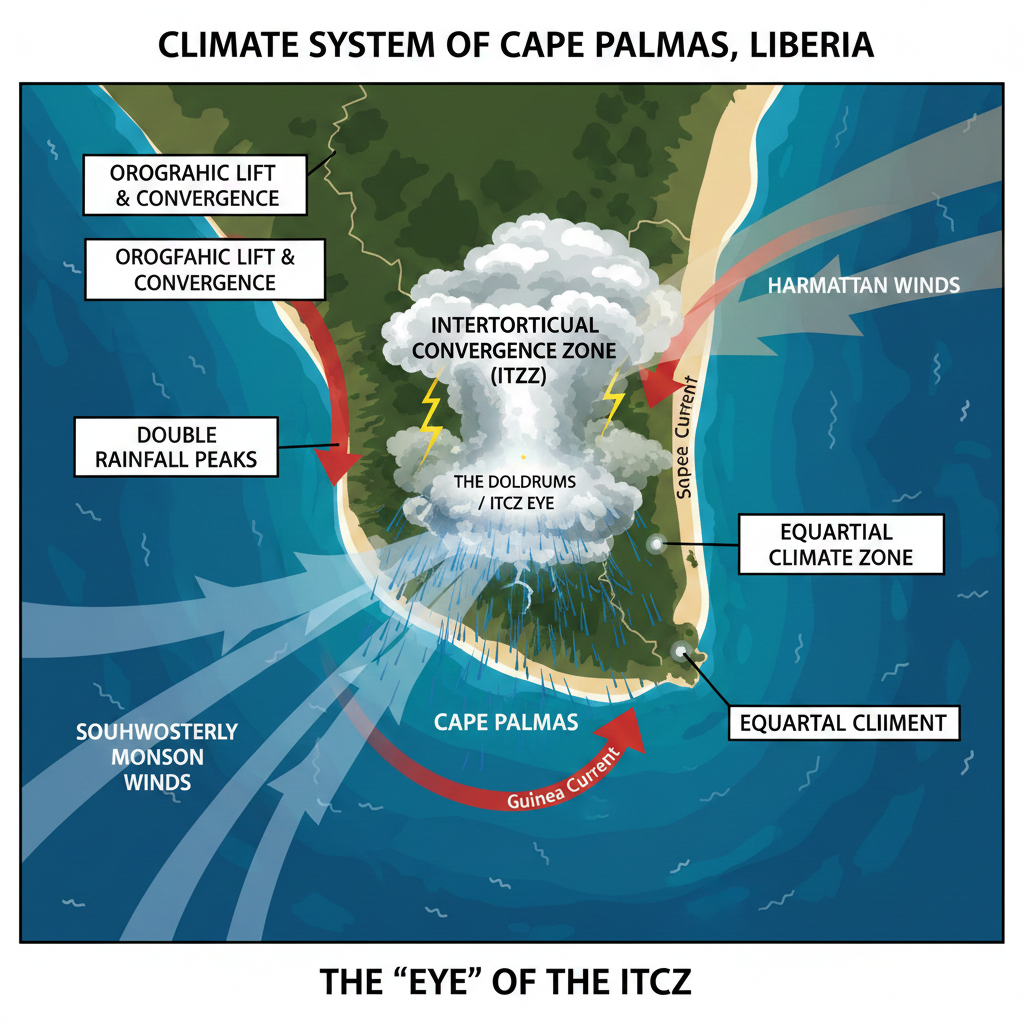
Most of Liberia follows a strict tropical monsoon cycle—six months of rain followed by six months of sun. However, Cape Palmas sits within an Equatorial Climate zone, resulting in a weather pattern that feels “different” even to other Liberians.
- Rain Year-Round: Unlike the rest of the country, Harper has no truly “dry” month. Even in December and January, when the rest of Liberia is bone-dry and dusty, the Cape receives significant rainfall.
- The Double Rainfall Peak: While Monrovia experiences one massive peak in rain during July or August, Harper experiences a “double maximum.” The city sees two separate peaks in rainfall intensity as the weather systems migrate across the equator.
- The Harmattan Shield: In the winter, the dry, dusty Harmattan wind from the Sahara blankets much of the country in a brown haze. At Cape Palmas, the Atlantic moisture usually “wins” the battle, keeping the region green and humid while the rest of the country turns dusty.
At the “Eye” of the ITCZ


To understand Harper’s weather is to understand the Intertropical Convergence Zone (ITCZ)—the belt where Northern and Southern Hemisphere trade winds collide. Cape Palmas acts as a geographic “anchor” for this zone.
Because the coastline takes a sharp 90-degree turn at the Cape, the ITCZ often “snags” on this corner. This creates a permanent state of convergence, where air is forced upward, triggering frequent, localized thunderstorms. This phenomenon also creates the “Doldrums”—eerie, heavy periods of absolute stillness where the air feels “stuck” before a massive afternoon downpour.
The “Cape Effect”: The constant sea breezes at Cape Palmas act as a natural air conditioner. While the humidity is high, the temperature is remarkably stable, rarely moving outside a narrow range of 74°F to 88°F all year long.
A “Perfect Storm” for Fishing
The same geography that creates unpredictable weather also makes Cape Palmas one of the most productive fishing zones in West Africa. The combination of the “turning” coast and the ITCZ creates a biological goldmine.
1. The Nutrient Upwelling
As the Guinea Current hits the sharp corner of the Cape, it is forced away from the shore. This creates an upwelling, pulling cold, nutrient-rich water from the deep ocean to the surface. This “fish magnet” feeds massive blooms of plankton, attracting schools of sardines, bonga fish, and herring.
2. Deep Water Proximity
Unlike the flat, sandy continental shelf found elsewhere in Liberia, the shelf at Cape Palmas is narrow and rocky. Deep-sea giants like Tuna, Marlin, and Barracuda can be found much closer to the shore here than in Monrovia or Buchanan. The rocky seafloor also provides a natural fortress for high-value species like Snapper and Grouper, as it prevents industrial trawlers from overfishing the area.
3. The Daily Rhythm of the Kru Canoe
Local artisanal fishers have become expert meteorologists, timing their departures to the “ITCZ Clock”:
- The Morning Window: Fishers take advantage of the “Doldrums”—the calm morning winds—to launch their canoes.
- The Afternoon Squall: They must return before the afternoon convective storms drop, reading the stillness in the air as a warning of impending rain.
The Cost of Abundance

While the waters are rich, the environment presents unique challenges. The extreme humidity (often above 82%) makes traditional sun-drying of fish nearly impossible. As a result, the local economy relies heavily on “smoking” fish, which puts pressure on local mangrove forests for firewood. Furthermore, the “Cape effect” creates powerful, unpredictable surf, making the simple act of launching a boat a high-stakes skill.
Cape Palmas remains a place of geographic extremes—a junction of currents, winds, and cultures that stands as the true sentinel of the West African coast.