
by Rocheford T. Gardiner

Recent days have seen a familiar yet unsettling rhythm emanating from Washington concerning Iran’s nuclear ambitions: a simultaneous beat of stern warnings and an open hand for diplomacy. This mixed messaging, while perhaps strategically calculated, creates a volatile atmosphere in the Middle East, a region already on edge, and is keenly observed by allies like Israel, whose security calculations are intrinsically linked to these developments.
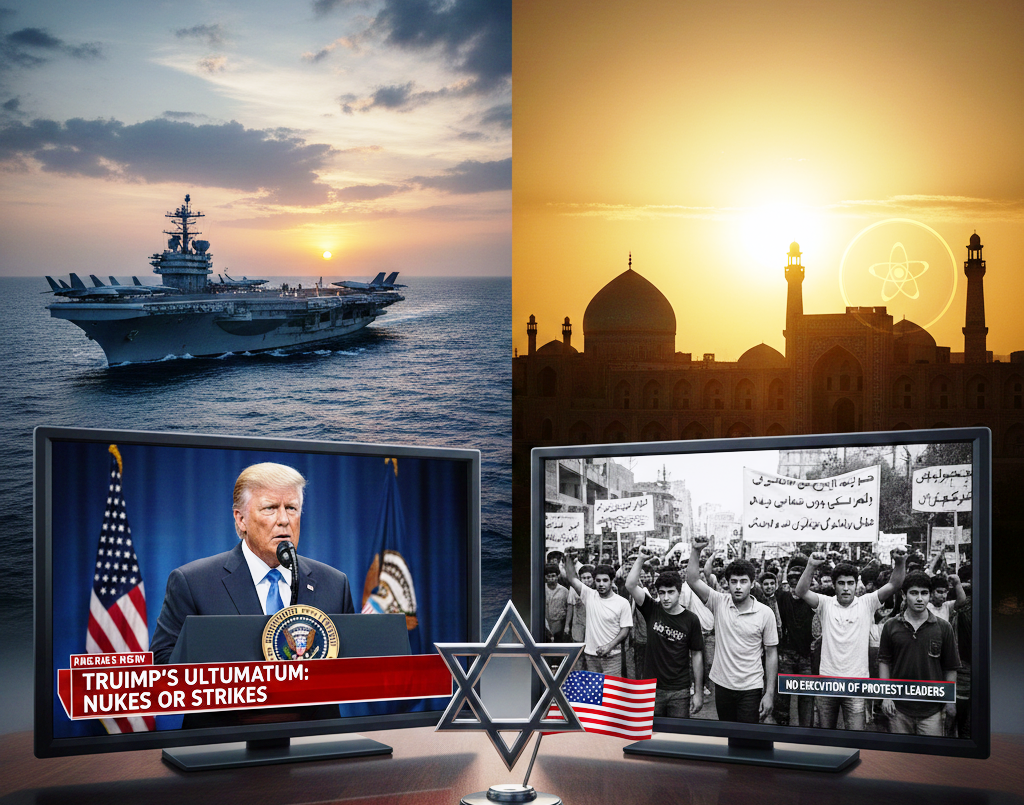
The latest crescendo came with President Trump’s direct admonition to Tehran: come to the negotiating table or face potential military action. This stark ultimatum was underscored by tangible troop and equipment movements to the Middle East, a clear signal of enhanced readiness and a projection of force designed to lend weight to the President’s words. For many observers, this echoes past strategies of “maximum pressure,” aiming to compel Iran into concessions through the credible threat of escalation.
Meanwhile, the Iranian regime responded defiantly: “Our finger is on the trigger.”

Yet, this hardline stance is juxtaposed with a recent, less confrontational episode. The U.S. government had previously issued strong warnings against the execution of protest leaders in Iran, suggesting military action could be a consequence. While the executions, fortunately, did not proceed in those specific cases, the fact that such a threat was made and then seemingly averted without military intervention adds a layer of complexity to Washington’s resolve. It raises questions about the threshold for action and whether the “or else” rhetoric carries the same weight across different scenarios.
This oscillation between sabre-rattling and implied restraint is not lost on regional players, particularly Israel. For Jerusalem, Iran’s nuclear program represents an existential threat, and any perceived weakening of U.S. resolve or a purely diplomatic track without robust enforcement mechanisms is a source of profound concern. Israel has historically advocated for a firm stance against Iran, viewing any Iranian nuclear capability as unacceptable and maintaining its right to self-defense, even unilaterally.
The “Israeli influenced factor” in Washington’s policy cannot be overstated. Powerful lobbying efforts and deep strategic ties ensure that Israeli security concerns are a significant consideration in U.S. decision-making regarding Iran. While the U.S. has its own strategic interests in preventing a nuclear-armed Iran and maintaining regional stability, the urgency and specific demands often voiced by Israel frequently resonate within Washington’s corridors of power. This influence can push for a more hawkish approach, even as other voices within the U.S. administration might lean towards de-escalation or a more protracted diplomatic effort.
The current strategy appears to be an attempt to leverage the threat of force to open a door for negotiations. However, this high-stakes approach carries inherent risks. Iran, for its part, has consistently rejected what it perceives as coercive diplomacy and has often responded to threats with defiance, further complicating the path to any meaningful dialogue.
As troops deploy and rhetoric intensifies, the international community watches nervously. The question remains whether Washington’s dual strategy of aggressive posturing and conditional dialogue will successfully bring Iran to the negotiating table on terms favorable to the U.S. and its allies, or if the mixed signals will ultimately sow confusion, embolden hardliners, and inadvertently propel the region closer to conflict. The delicate balance between deterrence and provocation has rarely been so precariously poised.
Adding to this conundrum are lessons learned from the recent 12-day war of June, 2025, between Israel and the United States on the one hand, and Iran on the other.
Arguably, Israel (and the United States) did not get the desired result. In fact, Iran pulled up a rather elaborate surprise, with the amazing display of Russian made/technology supplied missiles, which precisely struck Israel’s strategic and well-guarded targets, despite the deployment of US Patriot and Iron Dome missile defense systems.
Possibly, we might be only weeks or days away from a full scale American onslaught on Iran and the stakes keep getting higher. It is anyone’s guess what the resulting outcome will feel like – militarily, economically and geopolitically.
Things and times