
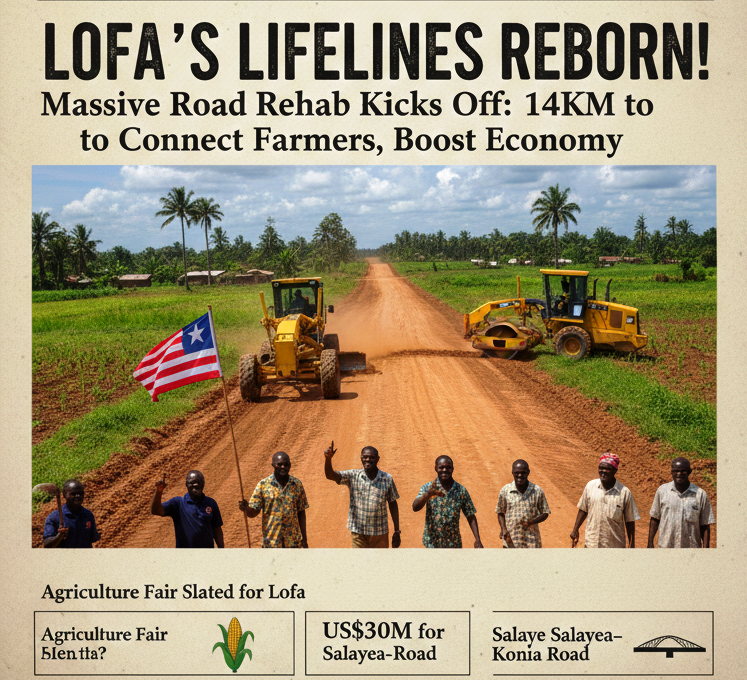
LOFA COUNTY, LIBERIA – A new era of connectivity and economic revitalization has dawned in Lofa County, Liberia’s vital “Breadbasket.” The Ministry of Agriculture has officially launched a comprehensive rehabilitation project targeting 18 crucial rural road lots, spanning a total of over 144 kilometers across six key districts. This ambitious undertaking, part of the Tree Crops Extension Project II (TCEP II), promises to be a game-changer for thousands of farmers and communities long isolated by dilapidated infrastructure.
The rehabilitation efforts will focus on critical feeder roads in Salayea, Voinjama, Kolahun, Zorzor, Quardu Gboni, and Foya districts. These arteries are the lifelines for Lofa’s agricultural sector, transporting essential produce like cocoa, coffee, palm oil, and various food crops from farms to local markets and beyond. For years, the poor state of these roads has led to staggering post-harvest losses, inflated transportation costs, and limited access for farmers to sell their goods, often trapping them in cycles of poverty.
“This is more than just fixing roads; it’s about empowering our farmers and unlocking Lofa’s full potential,” declared a representative from the Ministry of Agriculture at a recent ground-breaking ceremony in Voinjama. “By reconnecting these communities, we are directly investing in food security, economic growth, and the livelihoods of countless Liberians.”

The project is generously funded by the International Fund for Agricultural Development (IFAD), a specialized agency of the United Nations dedicated to eradicating poverty and hunger in rural areas of developing countries. IFAD’s commitment underscores the international recognition of Lofa’s pivotal role in Liberia’s agricultural landscape and the urgent need for infrastructure development to support its growth.
Expected Impact:
- Reduced Post-Harvest Losses: Improved roads will enable faster and more efficient transport of perishable goods, significantly cutting down on spoilage.
- Lower Transportation Costs: Farmers will incur less expense in getting their produce to market, directly increasing their profit margins.
- Enhanced Market Access: Communities previously cut off will gain easier access to buyers, leading to more competitive pricing and greater opportunities for trade.
- Stimulated Local Economies: Increased commercial activity along these routes is expected to boost small businesses and create local employment.
- Improved Social Services Access: Beyond economic benefits, better roads will facilitate easier access to schools, healthcare facilities, and other essential services for rural populations.
The commencement of the TCEP II road rehabilitation aligns perfectly with President Joseph Boakai’s “ARREST Agenda,” particularly its emphasis on Agriculture and Roads. It also complements other major infrastructure developments in Lofa, such as the recently secured US$30 million for the paving of the 50-kilometer Salayea–Konia Road, funded by the Arab Bank for Economic Development in Africa (BADEA).
As heavy machinery rolls into the various districts, a palpable sense of hope and anticipation fills the air across Lofa County. This massive road rehabilitation project is poised to not only physically connect communities but also to weave a stronger economic fabric, paving the way for a more prosperous future for Liberia’s breadbasket.