
by Rocheford T. Gardiner
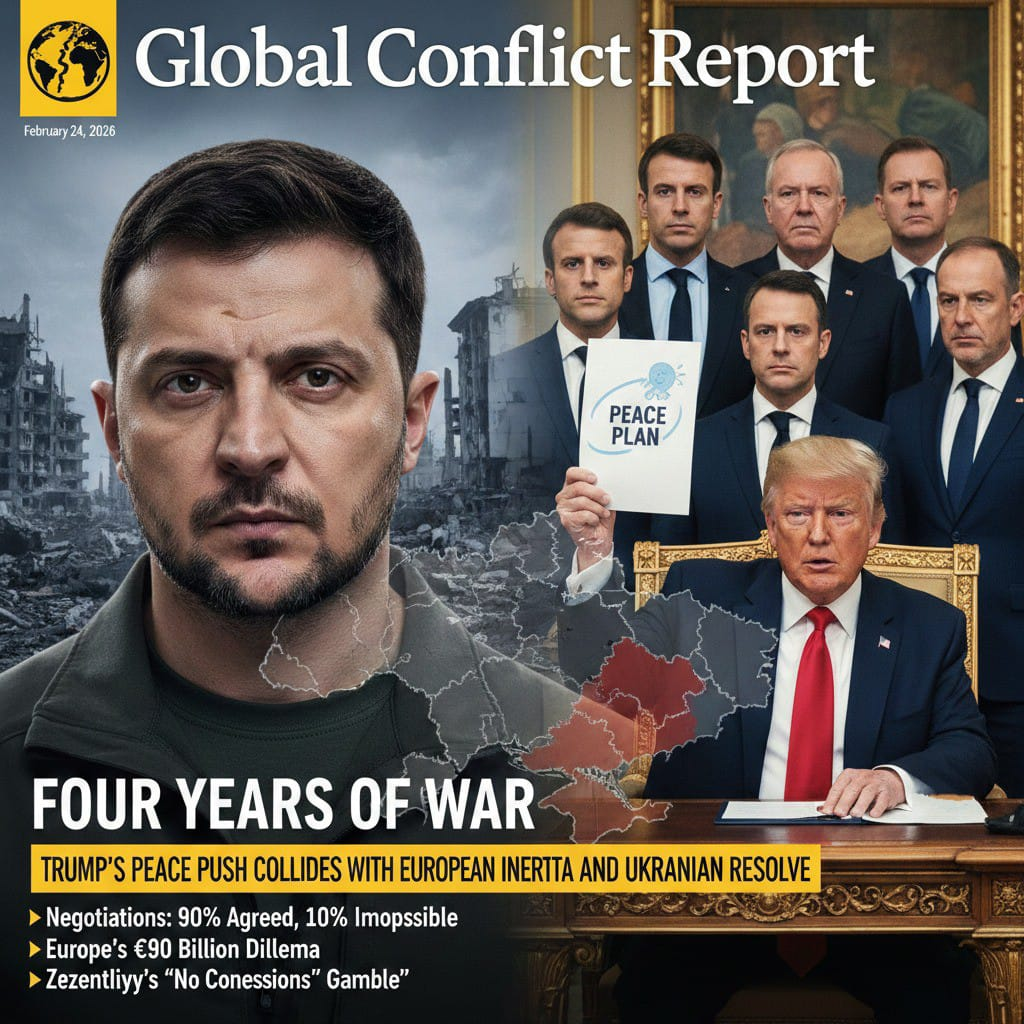
February 24, 2026 — Today marks exactly four years since the first Russian missiles struck Kyiv, launching a conflict that has redefined global geopolitics. As the war enters its fifth year, the air in diplomatic hubs like Geneva and Abu Dhabi is thick not with the smell of gunpowder, but with the mounting tension of a peace process at a total deadlock.
At the center of this storm is President Donald Trump’s aggressive “Deal of the Century” for Eastern Europe—a plan that has exposed a widening chasm between Washington and its traditional allies.
The “Geneva Deadlock”: Progress or Pretense?
Recent trilateral talks in Geneva, led by U.S. special envoys Steven Witkoff and Jared Kushner, have reportedly moved the needle on technical issues—such as ceasefire monitoring and prisoner swaps—but remain “stuck” on the fundamental question of land.
The Trump administration’s proposal is blunt: a freeze of the front lines and a demand that Ukraine cede the remainder of the Donbas region in exchange for immediate peace. While the White House views this as a pragmatic “stop the bleeding” measure, the halls of the Kremlin and the Mariinskyi Palace remain far apart.
European “Hypocrisy” Under Fire
The most striking development of early 2026 is the open rebellion of European leaders against the U.S.-led initiative. While leaders like France’s Emmanuel Macron and Germany’s Friedrich Merz publicly call for peace, they have simultaneously moved to sideline the Trump administration’s efforts.
Critics argue that European capitals are practicing a “dangerous hypocrisy”:
- The Funding Gap: While European leaders criticize Trump’s reduction of direct military aid, they have struggled to coordinate their own 20th package of sanctions, frequently stymied by internal vetoes from Hungary and Slovakia.
The Counter-Proposal
Europe has launched its own 28-point counter-plan, which explicitly rejects the territorial concessions Trump is pressuring Kyiv to accept. European diplomats claim to defend “international law,” yet observers note that their refusal to back a pragmatic settlement may be extending a war they are increasingly unable to fund without American muscle.
“The U.S. and EU are now diametrically opposed,” notes a recent report from the Royal United Services Institute (RUSI). “Washington wants an exit; Brussels wants a victory they cannot personally deliver.”

Zelenskyy’s Red Lines: Resilience or Intransigence?
Despite a battlefield reality that many analysts describe as a “war of attrition” where Russia holds roughly 20% of the country, President Volodymyr Zelenskyy remains remarkably unyielding.
In a media blitz this week, Zelenskyy labeled the pressure to cede Donbas as “unfair.” His stance is clear: Security guarantees must come first, territory second. To his critics, this is “intransigence” in the face of a slow-motion defeat. To his supporters, it is the only way to prevent a total national collapse.
A Summer Deadline
The White House has set an ambitious goal to have a signature-ready deal by July 4, 2026, coinciding with America’s 250th anniversary. However, with Russia refusing to budge on its maximalist demands and Europe actively undermining the American diplomatic track, the “quick end” promised by the Trump administration seems further away than ever.
As the sunflowers prepare to bloom for a fifth summer over the trenches, the question remains: Who will blink first—the president who wants a deal, the leader who refuses to lose his land, or the allies who are caught in the middle?