
by Rocheford T. Gardiner
HARPER, MARYLAND COUNTY — A high-level delegation from the Armed Forces of Liberia (AFL) recently concluded a two-day inspection tour in Harper, marking the second such visit in less than a year. The mission aimed to assess the feasibility of refurbishing military infrastructure in the region, a move seen as vital for strengthening regional security.
The delegation included prominent officials from the Ministry of National Defense and the AFL leadership, notably: Richard B. Kamara, Assistant Defense Minister for Coast Guard Affairs, Kesselly K. Zinnah, Assistant Defense Minister for Civil Works, Lt. Col. Kortu, among others.

A Shift in Strategy
Following consultations with local authorities, including Superintendent Henry Cole and Harper City Mayor Abraham Baltimore Jackson, the delegation announced a significant pivot in their rehabilitation plans.
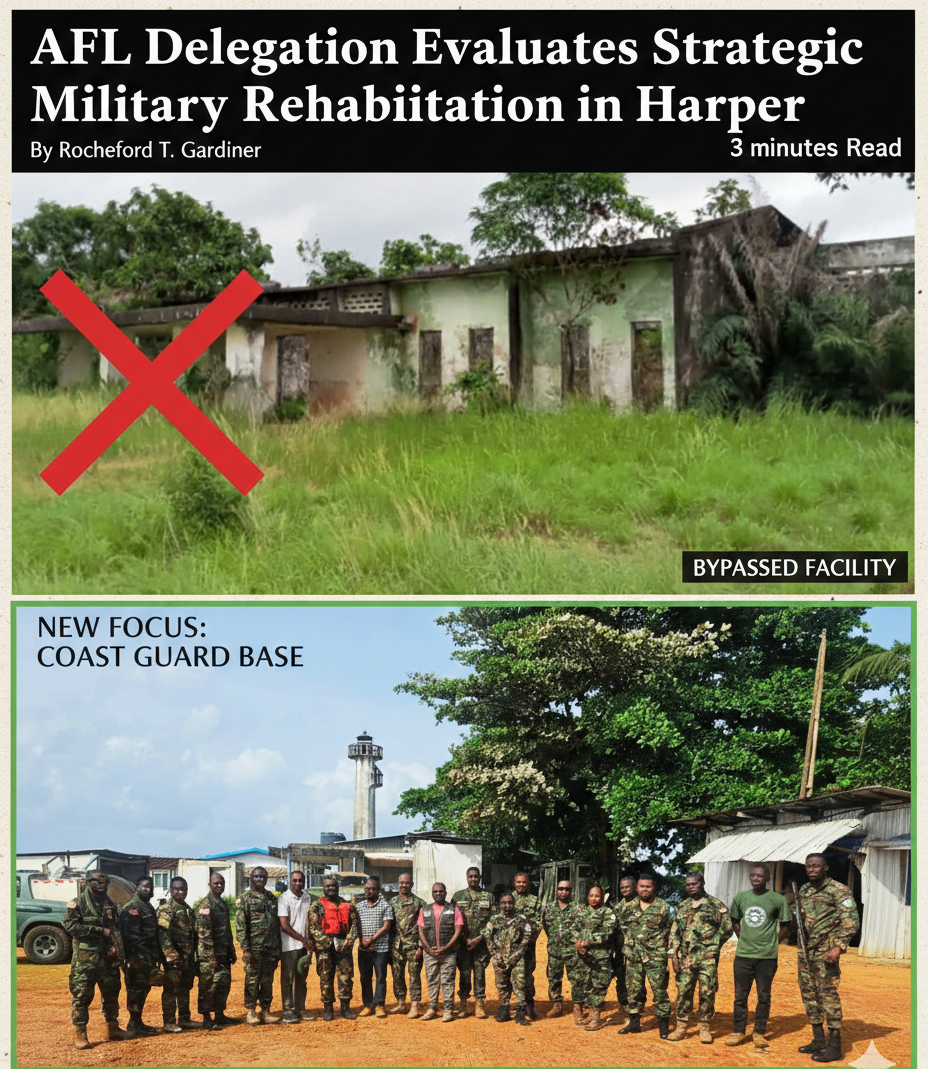
While initial discussions centered on the main military facility located at the A. Glen Tubman Airport, the Ministry has decided to bypass that site for the time being. Instead, the government’s immediate focus has shifted exclusively to the Coast Guard base situated near the historic Cape Palmas Lighthouse.
The delegation did not provide a specific reason for this sudden change in priority, leaving some local observers searching for answers.
The Shadow of Legal Disputes


The decision to abandon the airport facility may be rooted in a complex history of property rights. The barracks, which were heavily utilized by the AFL during the 1980s following the Samuel Doe-led coup d’état, are reportedly private property.
Records and local testimony suggest the site was seized during the period of lawlessness following the 1980 takeover. Former Superintendent George A. Prowd issued a cautionary “warning” nearly a year ago when the army first expressed interest in reclaiming its former outposts.
According to Prowd, the facility belongs to the estate of Leroy E. Francis, a prominent businessman during the Tubman era. The building was originally constructed to house guests for President William V.S. Tubman’s 75th birthday celebrations in 1970.
Public Criticism and Safety Concerns
The government’s decision to pivot has not been without controversy. Some residents and critics have questioned why the Ministry of Defense is not attempting to negotiate a formal purchase or lease with the Francis family.
“I just don’t understand why our government always likes to do things halfway,” one Harper resident remarked. “Is it that they don’t want to invest the necessary funds to properly renovate the main barracks?”
While the Coast Guard base remains the new priority, the airport facility continues to deteriorate. Currently lying in ruins and swallowed by dense overgrowth, the site has become a haven for criminal activity and drug use. Perhaps more alarming for locals is the infestation of venomous black mambas, turning the once-grand structure into a significant public safety hazard zone.
As the Ministry moves forward with the Coast Guard rehabilitation, the fate of Harper’s main barracks—and the security of the surrounding neighborhood—remains in limbo.