
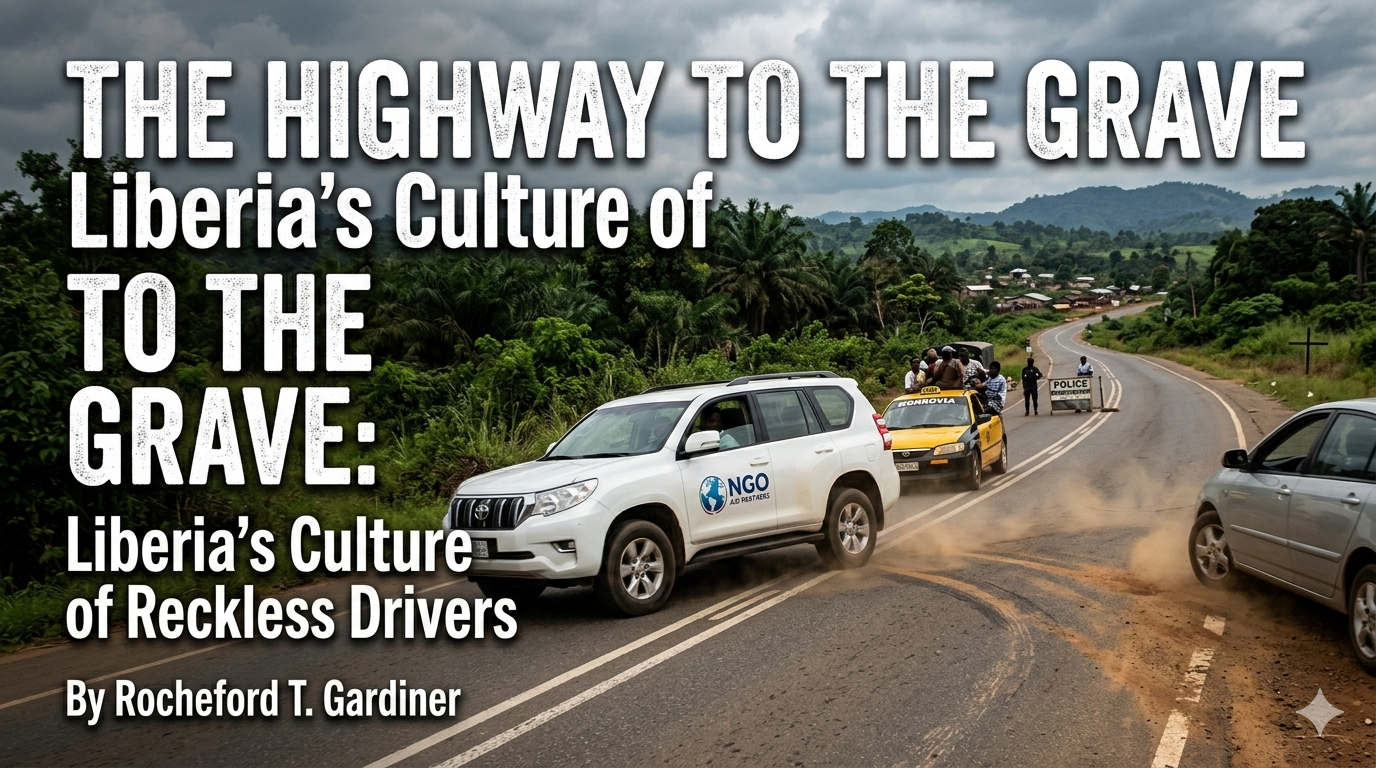
by Rocheford T. Gardiner
The sight of two NGO vehicles racing toward Pleebo (Maryland County, Liberia) a year ago was more than just a momentary lapse in judgment; it was a terrifying snapshot of the anarchy defining our roads. As I watched them jockey for position, a single, chilling thought took hold: Imagine the outcome if the bike the other “overtaking” driver had forced off the opposite lane, had been a truck.
The reality we face today is grim. Most accidents in Liberia are not mistakes —they are entirely avoidable consequences of a system that has broken down at every level. From the driver’s seat to the passenger’s silence, we are flirting with fatality.
A Generation of “Hollywood” Drivers
The vast majority of drivers on our roads today are young, reckless and immature. Fueled by adrenaline and a desperate need to impress peers or the opposite sex, they treat our highways like movie sets. They operate under the lethal delusion that Hollywood stunts are reality, playing with lives as if they were children’s toys. It is not just “youthful exuberance”; it is a profound and dangerous stupidity.
Technical Ignorance and the “Tireman” Fallacy
Even if a driver follows the speed limit, they are often betrayed by technical ignorance. Consider the Ganta-Monrovia route. I have seen cars hitting 120 km/h on stretches recommended for an 80 km/h maximum. These are used vehicles with worn, uneven tires, often over-inflated to 60 psi instead of the required 30-32 psi.


When you combine that pressure with tarmac temperatures reaching up to 60°C (14-0°F), you aren’t driving a car—you’re driving a ticking time bomb. Our vulcanizers, colloquially known as “tiremen,” are equally complicit. They ignore manufacturer specifications, pumping air until a tire “looks okay” (by “eye measurement”).
The Silence of the Passenger
Perhaps most frustrating is the culture of silence. Passengers—the very people whose lives are at stake—often remain ignorant or just as “silly” as the driver. When a rare voice of reason attempts to caution a reckless driver, they are often met with hostility from their fellow commuters. “Don’t bring your bad luck talk here,” they shout, or “Leave the driver before you confuse him.” In our attempt to avoid “bad luck,” we are actively inviting the undertaker.
A Failure of Enforcement
Where is the law? Law enforcement is either weak or functionally non-existent. When police are present, their focus rarely lands on reckless driving or safety violations. Instead, they prioritize “squeezing a few bucks” for overloading, ignoring the high-speed maneuvers that actually kill people.
I have reached a point where I abhor the idea of traveling to Monrovia in commercial vehicles or even some NGO cars. The lack of professionalism has turned our transit system into a lottery where the prize is too often a coffin.
We can no longer afford to “play like kids” with multi-ton machines. Until we demand proper training, strict enforcement, and a culture of accountability from every passenger, we are all just waiting for the next tragedy