
credit to Madam Gbuo Wilson-Miller
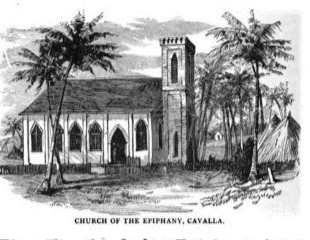
CAVALLA, Liberia — In the mid-19th century, amidst the rugged coastal landscapes of Cavalla, a vision of “glorious effulgence” began to take physical form. Historical records and excerpts from the Spirit of Missions reveal the arduous, near decade-long journey to construct the Church of the Epiphany—a project defined by unwavering faith, logistical grit, and the labor of the local Grebo community.
A Vision Takes Root
The journey began in earnest on September 3, 1849, when the Reverend John Payne issued a stirring appeal for a “material Church of the Epiphany.” By March 21, 1851, that dream moved closer to reality. The Bishop-elect, joined by Reverends Hoffman, Hening, and Rambo, gathered to lay the cornerstone.
In a moment of profound symbolism, a copper box containing the Holy Scriptures, a Book of Common Prayer, and various religious publications was interred beneath the stone. This act signaled a “renewed faith in the future of the Mission work” and anchored the church’s spiritual foundation in the African soil.
Building Against the Odds
The path from cornerstone to completion was fraught with geographical and logistical hurdles. Letters from 1852 describe the “hard work” of building at Cavalla, where the mission depended almost entirely on the local population for the manual transportation of heavy materials. Progress was often agonizingly slow:
- January 1852: Essential timber finally arrived from America after a series of long delays.
- Late 1852: Construction hit a critical bottleneck when suppliers in Monrovia were unable to procure the necessary bricks.
- Resourcefulness: Faced with a shortage of wood needed to burn shells for lime, the mission cut a new road across the Grahway meadow to the swamp. They purchased a yoke of oxen and a cart to bypass the delays and accelerate the pace of labor.
The Rise of the Stone Structure
By 1855, the structure had shifted from a hopeful foundation to a looming reality. Reports described a $30 \times 70$ foot stone edifice designed to serve a surrounding population of three thousand people.
On January 11, 1855, Bishop Payne reported that the stonework was largely completed, with only a portion of one gable and the upper section of the tower remaining. “If mechanics will do their part,” the Bishop wrote with cautious optimism, “the building may be finished during the present dry season.”
A Growing Community

The church was far more than a feat of masonry; it was the heartbeat of a burgeoning community. During the Cape Palmas Convocation in August 1856, the grounds teemed with life. Records indicate that roughly 350 people—including local Christians and villagers—assembled for services conducted in the Grebo language, marking a significant milestone in the mission’s cultural integration.
A Legacy of Leadership
The early success of the Epiphany mission was steered by a dedicated line of clergymen who became instrumental figures in West African ecclesiastical history:
| Name | Role/Legacy |
| Bishop John Payne | The primary visionary and first Bishop of the jurisdiction. |
| Rev. John Gottlieb Auer | A tireless educator who later served as Bishop. |
| Rev. Martin Parks Keda Valentine | A key figure in the local ministry and education. |
| Rev. Thomas Church Sidi Gabla Brownell | A prominent Grebo clergyman and missionary. |
Today, these archives serve as a testament to the resilience of the early congregation and the complex, collaborative effort required to build a lasting landmark in the heart of Cavalla.
