
from our Regional Desk
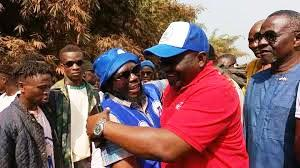
Zwedru, Grand Gedeh County – Political leader of the Citizens Movement for Change (CMC), Musa Hassan Bility, has ignited a fresh wave of political and developmental discourse in Grand Gedeh County with the launch of an ambitious initiative he terms a “credit union” for development. This past week, Bility’s presence in District 3 and Zwedru City has been marked by significant undertakings, including the construction of boreholes, rehabilitation of critical road networks, and the provision of micro-loan schemes to local residents.

The initiative, while framed as a benevolent development effort, carries an explicit political undertone. During his engagements, Bility openly communicated to the populace that the services being rendered are an investment in the community, with an expectation of electoral reciprocity. He stated that the “repayment” for these developmental projects would be the unwavering support of Grand Gedeh voters for the CMC in the upcoming 2029 general elections.
“We are here to lay the groundwork for progress, to address the immediate needs of our people,” Bility reportedly told a gathering in Zwedru. “But let it be clear, this is a partnership. We provide the development now, and you, the citizens, repay us with your votes when the time comes.”
Critics are quick to label this approach as “vote buying” or a shrewd political strategy to secure future electoral gains through direct material incentives. Indeed, this kind of “interventions” have become a common trend in Liberian politics, where ordinary electorates (usually extremely poor), are coerced into voting a political party or individual, based solely on how much food, money of beverage the individual or political group can provide. In essence, they go for the “highest bidder.”
However, supporters argue that in a region often overlooked for development, any initiative that brings tangible improvements to infrastructure and livelihoods is a welcome change, regardless of its political motivations.
The CMC’s move comes at a crucial time as political parties begin to position themselves for the next electoral cycle. By embedding developmental projects with a clear electoral expectation, Bility is attempting to forge a direct and transactional relationship with the electorate, challenging traditional campaign strategies in rural Liberia.
The long-term impact of this “credit union” model on the political landscape of Grand Gedeh and Liberia at large remains to be seen. However, it undoubtedly sets a precedent for how political patronage and community development might intertwine in the run-up to future elections.