
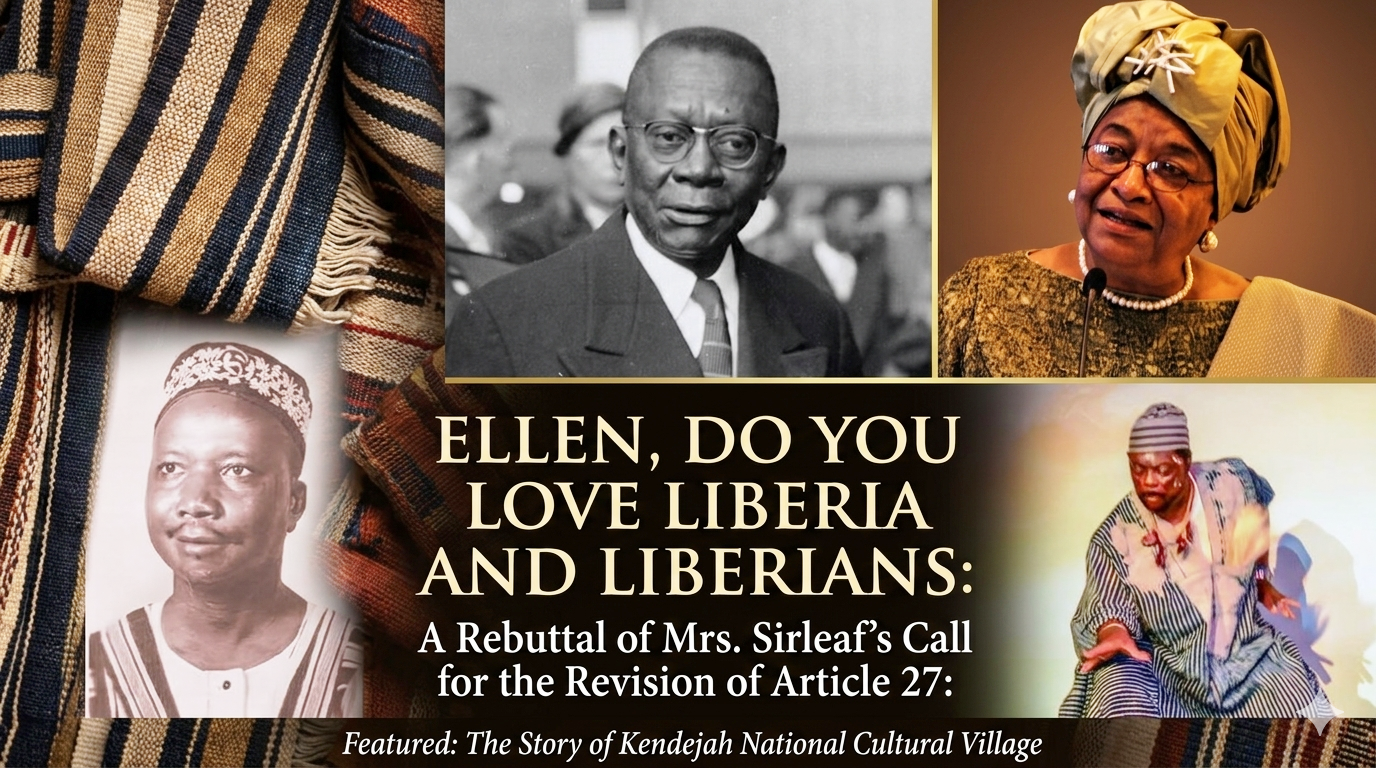
by Rabbi Joseph Gbaba Ed. D
Part Two
The willful seizure of or destruction or willful damage to cultural property of any nation and people is considered a violation of International Humanitarian Law (IHL, Volume II, Chapter 2, and Section C).
Consequently, Mrs. Sirleaf’s willful seizure of or destruction or willful damage of the Kendejah National Cultural Center was and is a violation of International Humanitarian Law because Article 56 of The Hague Regulations prohibits “all seizure of, and destruction, or intentional damage done to” institutions dedicated to religion, charity, education, the arts and sciences, historic monuments and works of art and science. (The Hague Regulations, Article 56 (cited in Vol. II, Ch. 12., §§ 355–356).
To add injury to insult, Kendejah, a national cultural shrine and property and the indigenous soul of the Liberian nation was SOLD to foreign businessman to build a 78-bedroom resort, with the vicious intent to wipe out indigenous Liberian history and culture during a period in Liberian history when there was human genocide taking place and Liberians held under gunpoint by rebels some of whom Mrs. Sirleaf admitted to funding. The million-dollar question is, “Where is the money that was given to the Liberian government for the sale of the
Kendejah National Cultural Village?
As I stated before, the preservation of the history and culture of Liberia is not the sole responsibility of one individual. It is our collective responsibility to preserve our heritage and to be nationally conscious. The recent attempt by Guinea to encroach on Liberian territory in Lofa and the repeopling and huge surge of Burkinabe and other foreign nationals in Grand Gedeh County speak to the concerns that are being raised in this article.
If you are a patriotic Liberian citizen or friend of Liberia, I urge that you come to our refuge and donate to the Dehkontee Artists Theatre Performing Arts Fundraiser to assist me provide civic and peace education programs on radio, TV, live performances in Liberia and to begin the construction of the first school of the performing and visual arts. DATI is a 501 (c)(3) nonprofit educational and cultural organization. Your donation will be tax deductible.
Here is how you can donate:
1. CashApp: $JosephGbaba, tel. (267) 973-1709
2. Zelle: Joseph Gbaba, Tel. (267) 973-1709
3. Write check or money order to:
Dehkontee Artists Theatre, Inc., P. O. Box 143, Clifton Heights, PA 19018
Remember Liberia’s sovereignty is at stake. We need to educate our people so they can be alert because we have influential Liberians who are selling our sovereignty while you and I are inactive, doing nothing to counter their seditious and espionage activities.
Below is the story of Kendejah. Please share this article with family and friends because this does not seem to be newsworthy for some leading Liberian dailies, even though it is a national document.
Rationale for the Establishment of Kendejah National Cultural Village
The Kendeja National Cultural Village was established in 1964 through an Executive order during the reign of President William Vacanarat Shadrach Tubman, as part of his Integration and Unification Policy strategy. He developed the plan of establishing a national cultural center with the input of his Secretary of Information Services and Culture, Honorable E. Reginald Townsend (a politician of Americo-Liberian descent) and Mr. Townsend’s Deputy, Honorable Bai Tamai Moore, an indigenous cultural ethnographer.
In the same year, 1964, Tubman declared four leeward regions in the interior of Liberia as counties: Grand Gedeh, Nimba, Bong, and Lofa, to enhance national unity and integration. In view of the foregoing, President William V. S. Tubman also wanted indigenous Liberians to be meshed into the body politic of Liberia and to prove that Liberians from all sixteen ethnic groups could live together with one purpose and coexist peacefully. And that was exactly what Kendejah meant to all Liberians and the outside world, a national unity village of Liberian artists.
In addition, the establishment of Kendejah was designed to address the cultural conflict that emerged when the freed slaves emigrated to Liberia to establish a free, independent Black Nation on the continent of Africa, to prove that Blacks were capable of self-rule. Hence, the demolition of Kendejah dealt a fatal blow to Tubman’s Unification and Integration Policy. It shattered the hopes of Liberians being unified.
Moreover, Tubman wanted the people of Liberia to be integrated and so he was bent on bridging the “Country-Congau” barrier that existed since the coming of freed slaves from the United States to what is now called the Republic of Liberia.
The Beginning of Liberia’s Cultural Conflict
The coming of the freed slaves sparked a cultural conflict in which there were two distinct sets of citizens: indigenous Africans whose cultural beliefs, native languages, educational, religious, and social norms and values differed from the westernized cultural beliefs of ex-slaves who were westernized and that spoke a western language (English).
In addition, the Settlers developed and practiced the religious, governance systems, and beliefs of their slave masters.
Therefore, Kendejah was a litmus test and an aim of the Liberian government to respect and preserve indigenous Liberian culture.
Hence, Kendeja was designed as a panorama of Liberian tribal life to contrast with the growing influx of western culture and its influence on the lives of Liberians. Further, Tubman created Kendejah to preserve authentic indigenous Liberian history and culture so it would not be destroyed or wiped out.
Therefore, it was a deliberate attempt by Mrs. Sirleaf to wipe out indigenous Liberian culture, the culture of the majority, by selling Kendejah to a foreign businessman to build what I would term a “brothel” in place of a national cultural shrine.
Mrs. Sirleaf’s action was intentional, deliberate, so that Liberians can remain divided and become Africans perpetually enslaved to western culture and mentality. Also, note that this was done at the peak of the Liberian crisis when meaningful attempts should have been made to promote peace and reconciliation among Liberians.
Who Ran Kendejah and What Were Some Accomplishments of Kendejah?
In the beginning of the construction of Kendejah, there were approximately thirty-one tribal huts built and artists were selected from Liberia’s sixteen ethnic compositions to live together in harmony and to promote their indigenous culture at home and abroad.
According to information I gathered from Papa Bai T. Moore in the seventies when he mentored me as a cadet in the Bureau of Culture and Tourism, Roger Dorsinville, a Haitian writer who was in exile in Liberia served as the first artistic director of the Kendeja National Cultural Center. Later, a Liberian named James Emmanuel Roberts (AKA Khona Khasu) succeeded Mr. Dorsinville.
I had the privilege of working as Stage Manager of Blamadon Theatre Workshop under the adept leadership of Mr. Roberts who is a trained actor and director. He earned his Master of Fine Arts (MFA) in Theatre from Boston University. Mr. Roberts also inspired me to follow his footsteps, to pursue the MFA in Directing and Acting from The University of North Carolina at Greensboro and Honorable Bai T. Moore wrote my letter of recommendation to the UNC-Greensboro School of Theatre so that I would return to Liberia to continue from where he stopped. Therefore, apart from Kendejah being a national cultural center, it was a symbol of national unity in Liberia.
The Demolition of Kendejah, the National Cultural Shrine of Liberia and the Negative Impact Its Willful Destruction Has in Restoring Peace and National Peace and Reconciliation in Liberia
For forty-three unbroken years before Kendejah was demolished, the Liberian national Cultural Center was one of the cultural hubs of Africa. International scholars and tourists frequented Kendejah for entertainment and to conduct cultural and ethnographical research as tourists and scholars do during the Safari tour every year in East Africa.
Thousands, if not millions of tourists, traveled to Liberia from all corners of the universe yearly to watch the Liberia National Cultural Troupe perform. In addition, the Liberia National Cultural Troupe won many international competitions for their well-choreographed, music and rhythmic drumbeats and dance steps and beautiful traditional choruses sung in various Liberian vernaculars.
For instance, the Liberia National Cultural Troupe participated in the First World Black and African Festival of Arts and Culture in Dakar, Senegal in 1966. They took first place at the International Dance Competition in Algiers, Algeria (July 21-29, 1969). Their African folk dance, moonlight ballets and stilt dance (the Glaykpen) blew the international spectators off their feet!
The Liberian National Cultural Troupe stepped on American soil and rocked the American Bicentennial Celebrations in Washington D. C., and they performed well at the World Fair in New Orleans in 1976. Then there was FESTAC (2nd World Black and African Festival of Arts and Culture held in Lagos, Nigeria) in 1977. Again, the Liberian National Cultural Troupe was sensational.
Besides, the Liberia National Cultural Troupe was the pride of the nation and President Tolbert proudly rewarded our distinguished and accomplished national artists by occasionally including the National Cultural Troupe on his entourage during many of his state visits abroad to showcase Liberian culture on the global stage.
Conclusion
In my opinion, asking lawmakers to revise the Constitution of Liberia during the tenure of President Joseph Nyumah Boika, when she could have done so during her own tenure speaks volumes and it is inappropriate. We do not want another bloodshed in Liberia. Mrs. Sirleaf must stay in her lane and give President Boikai a chance to complete his term peacefully. To members of the Liberian National Legislature, I urge you not to be fooled. Put Liberia first and maintain your dignity as lawmakers of the land.
Rabbi Gbaba
