
by Rocheford T. Gardiner
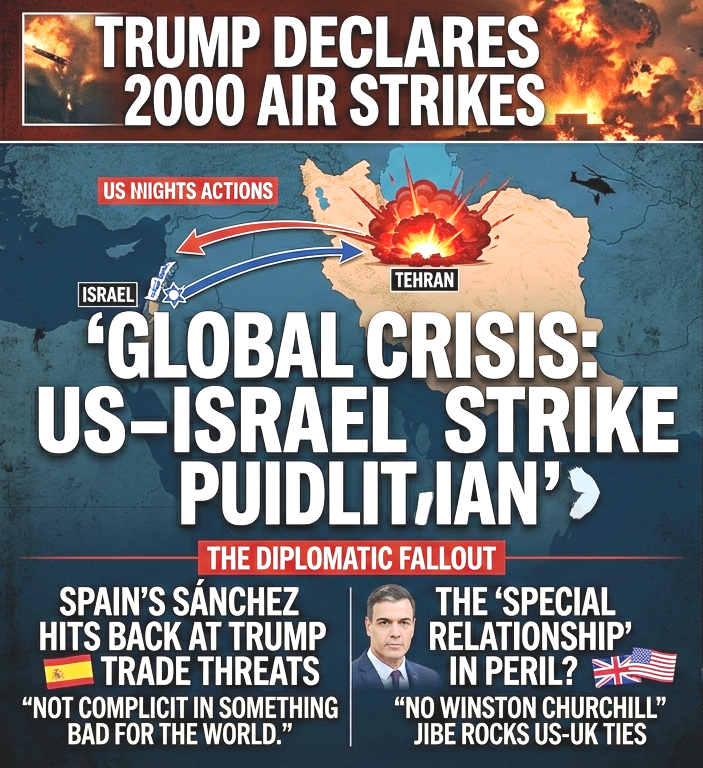
WASHINGTON / TEHRAN – The Middle East has spiraled into a state of total war as the United States and Israel intensify a massive air campaign against the Islamic Republic of Iran. In a series of provocative statements from the Oval Office, President Donald Trump claimed the U.S. has conducted more than 2,000 air strikes against Iranian targets since the start of operations on February 28, 2026.
Strikes and Counter-Strikes: The Front Lines
The military escalation, codenamed Operation Epic Fury by the U.S. and Operation Roaring Lion by Israel, has moved beyond border skirmishes into the heart of Iranian power.
Targeting the Capital – Israeli Defense Forces (IDF) claimed they have successfully hit security and paramilitary headquarters across Tehran. Footage from the ground appears to shows the destruction of the Special Police Command and several Basij paramilitary bases—sites central to the regime’s domestic security.
Iranian Retaliation – Tehran has not remained silent. Iranian forces launched a massive barrage of over 500 ballistic missiles and 2,000 drones targeting U.S. interests across the region.
Significant strikes were reported at the Al-Udeid Air Base in Qatar and near the U.S. consulate in Dubai. Reports indicate the U.S. has lost nearly $2 billion in military equipment in just four days, including a high-value early warning radar system in Qatar.
The “Irony” in the Gulf
Gulf states—including the UAE, Qatar, and Bahrain—are currently weighing their responses as they find themselves caught in a violent crossfire. While these nations have condemned Iranian “violations of sovereignty,” they face a mounting internal and regional paradox: their own territories are the primary launchpads for the U.S. strikes.
“It is apparent that they do not want the United States forces on their territories. However, they lack the “will” to ask them out,” a geopolitical analyst mentioned. “It is not so easy – I mean, you cannot just say to America –‘hey, pack up and leave.” “The Gulf countries were going to be very little involved and now they insist on being involved,” Trump remarked, noting the shift as Iran begins targeting civilian infrastructure like airports and hotels in Dubai and Sharjah in retaliation for the U.S. presence.
Transatlantic Rifts: Spain and the UK

The conflict is not just a military one; it has triggered a diplomatic “Russian roulette” among Western allies. Spanish Prime Minister Pedro Sánchez has emerged as the most vocal critic of the campaign in Europe. After banning U.S. aircraft from using Spanish bases for the offensive, Sánchez faced a blistering threat from Trump to sever all trade ties with Madrid. “We are not going to be complicit in something that is bad for the world… simply out of fear of reprisals from someone,” Sánchez stated in a televised address, summarizing his stance as “No to the war.”
The “Special Relationship” in Peril
In London, the mood is equally grim. President Trump sparked a firestorm by telling reporters that British PM Keir Starmer is “no Winston Churchill,” criticizing the UK’s initial refusal to allow strikes from British bases. Trump lamented that the UK-US bond is “not like it used to be.”
While Downing Street maintains the alliance is “staunch,” Starmer has insisted that he “does not believe in regime change from the skies,” opting instead to send the HMS Dragon to protect British assets in Cyprus rather than joining the offensive in Tehran.
What’s Next?
As the Strait of Hormuz faces potential closure and global oil markets brace for impact, the question remains: will this “pre-emptive” strike lead to the regime change Trump desires, or a prolonged regional conflagration?