
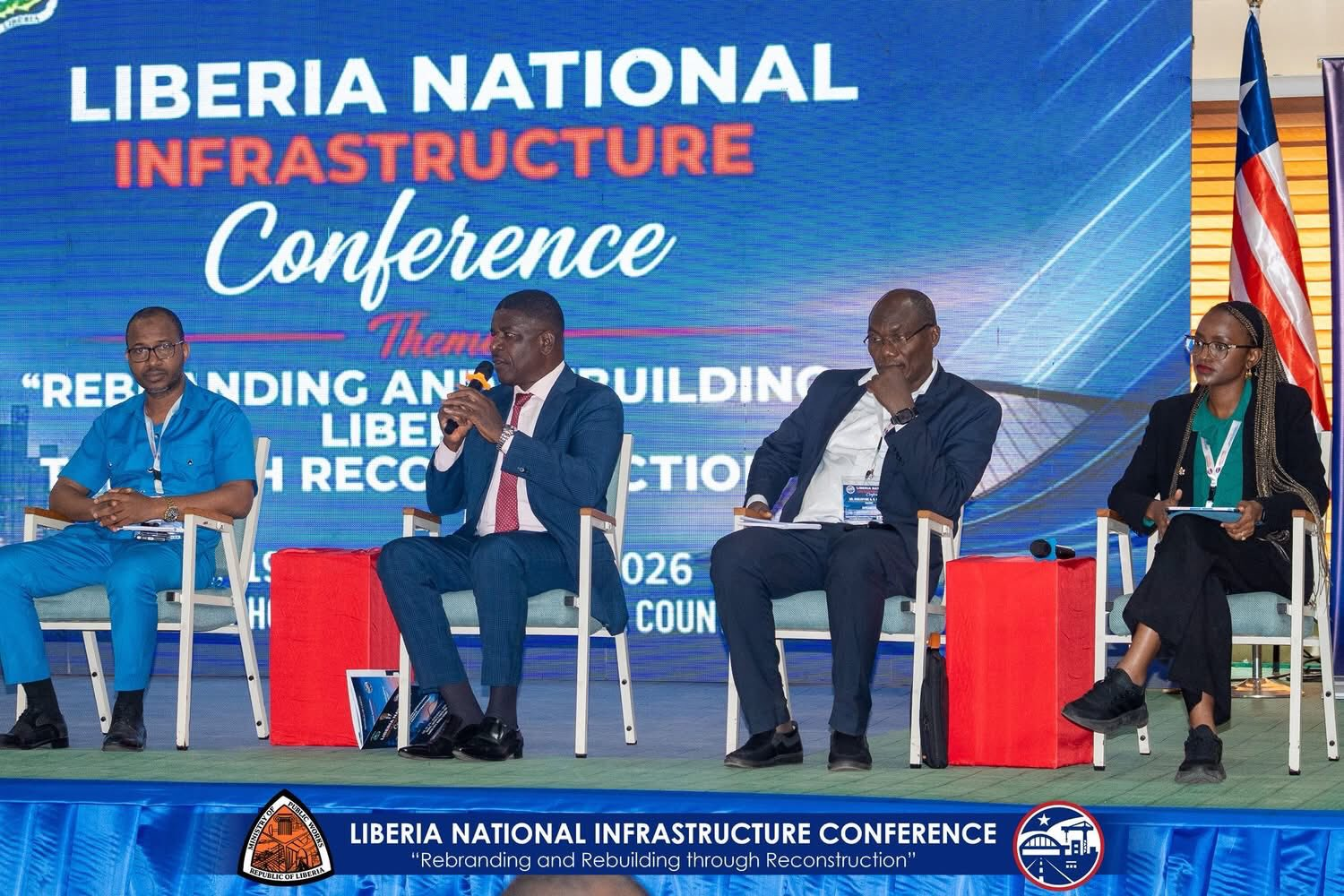
From the official MPW Facebook Page

Monrovia, Liberia – The Government of Liberia concluded the Liberia National Infrastructure Conference (2026) last week. Held from January 19–23 under the theme “Rebuilding and Rebranding Liberia through Reconstruction,” the summit gathered senior officials, international partners, and private sector leaders to tackle the country’s aging infrastructure and climate vulnerabilities.
The conference was officially opened by President Joseph Nyuma Boakai, Sr., who declared quality, people-centered infrastructure a non-negotiable prerequisite for wealth creation and long-term stability. “We must rebuild smarter, better, and more resilient,” the President emphasized, reaffirming his administration’s commitment to placing infrastructure at the heart of the national recovery agenda.
Key Sector Strategies
The five-day deliberation produced a comprehensive roadmap for several critical sectors:
- Roads & Transport: Experts called for structural reforms, including the introduction of tolling policies and stricter axle-load controls to preserve road life.
- Energy & ICT: Discussions focused on reducing system losses in energy and expanding fiber-optic connectivity to underserved rural areas, including a new subsea cable for network redundancy.
- WASH & Housing: The conference identified a need to transition to revenue-based financing for water services and the “decongestion of Monrovia” through the master planning of county capitals.
- Ports & Rail: Recognizing these as strategic economic assets, the communiqué highlighted the need for dredging, rehabilitation, and improved intermodal connectivity to position Liberia as a regional trade gateway.
A New Vision for Governance
The summit was not merely about construction but about institutional reform. Participants noted that fragmented planning and weak data systems have historically undermined infrastructure performance. To combat this, the conference resolved to institutionalize evidence-based planning and strengthen inter-ministerial coordination.
A major highlight was the recommendation to establish a “one-stop-shop” for investors, designed to centralize permits and regulatory clearances to boost investor confidence and unlock private capital through Public-Private Partnerships (PPPs).
“Infrastructure must be human-centered, inclusive, and dignity-enhancing.” — Conference Key Finding
The Path Forward
The conference concluded with the adoption of a formal Communiqué, calling for the immediate development of a Post-Conference Infrastructure Action Plan. This roadmap will be submitted to the Cabinet for approval to guide future budgetary allocations.
To ensure these promises turn into progress, stakeholders unanimously resolved to convene the National Infrastructure Conference every three years to monitor implementation and ensure measurable results for the Liberian people.