
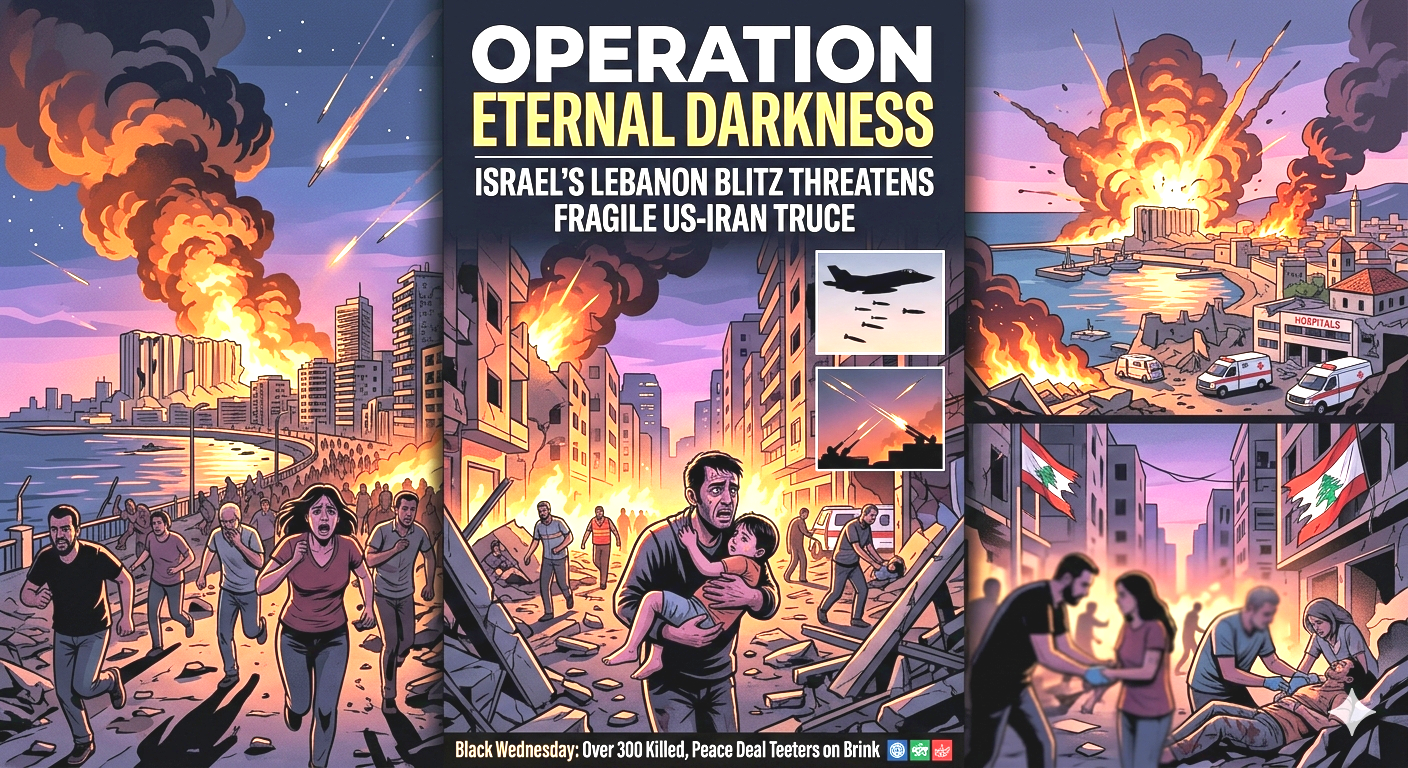
BEIRUT / WASHINGTON – A landmark two-week ceasefire intended to pull the Middle East back from the brink of total war is already facing a “lethal stress test.” On April 8, 2026—a day now etched in Lebanese history as “Black Wednesday”—Israel launched its most devastating aerial campaign of the war, just hours after the United States and Iran agreed to a temporary cessation of hostilities.
The surge in violence has left over 303 people dead and nearly 1,200 injured in a single afternoon, raising urgent questions about whether a peace deal that excludes Lebanon can survive its first 48 hours.
A Truce Born in Turmoil
The ceasefire, mediated by Pakistan and announced by U.S. President Donald Trump, was designed as a “cooling-off” period. Under its terms, Iran agreed to reopen the Strait of Hormuz and pause its nuclear enrichment in exchange for conditional sanctions relief and a halt to U.S. strikes on its infrastructure.
However, a critical “Lebanon Loophole” has emerged. While Pakistan, France, and Egypt maintain that the truce naturally extends to the entire region, Israeli Prime Minister Benjamin Netanyahu has been unequivocal: “Lebanon is not Iran.” Israel contends that its campaign against Hezbollah remains a separate, sovereign security necessity.
“Operation Eternal Darkness”
As the ink was still drying on the Islamabad agreement, the Israeli Air Force (IAF) deployed 50 fighter jets to carry out Operation Eternal Darkness. In a terrifying ten-minute window, over 100 munitions were dropped across Lebanon, including the first strikes on central Beirut without prior warning.
The human cost has been described by international observers as “catastrophic”:
- The Shmestar Massacre: An airstrike hit a cemetery in the Beqaa Valley during a funeral, killing ten mourners instantly.
- Targeting Healthcare: Doctors Without Borders reported that Hiram Hospital in Tyre sustained heavy damage, while a Lebanese Red Cross ambulance was struck in Qlaileh, killing three.
- Urban Devastation: In Beirut’s Corniche al-Mazraa, a bustling commercial district, journalists reported scenes of “total chaos” with charred bodies in vehicles caught in the rush-hour bombardment.
“This is a residential area. There is nothing military here,” said one distraught Beirut municipal official. “They are not fighting a militia; they are punishing a people.”
The Sabotage of Diplomacy
The political fallout is immediate. Iranian Foreign Minister Abbas Araghchi warned the BBC that the strikes are a “grave violation” of the spirit of the truce. Tehran faces a strategic dilemma: if it does not respond to the “massacre” of its primary ally, Hezbollah, it risks appearing weak; if it does respond, it voids the ceasefire and invites the “civilizational destruction” recently threatened by President Trump.
UN Human Rights Chief Volker Türk called the scale of the carnage “appalling,” stating that such actions “defy belief” and place “enormous pressure on a fragile peace.”
What Comes Next?
As Lebanon enters a national day of mourning, the international community is scrambling to close the loophole.
- The US Stance: The White House has characterized Lebanon as a “potential spoiler,” yet remains reluctant to pressure Israel into a full halt.
- The Iranian Ultimatum: Tehran has signaled that negotiations scheduled for Saturday in Islamabad will be “meaningless” if the bombing of civilians continues.
For now, the Strait of Hormuz remains technically open, but the skies over Beirut remain thick with smoke. If the “Eternal Darkness” campaign continues, the world’s most significant diplomatic breakthrough in years may be extinguished before the week is out.