
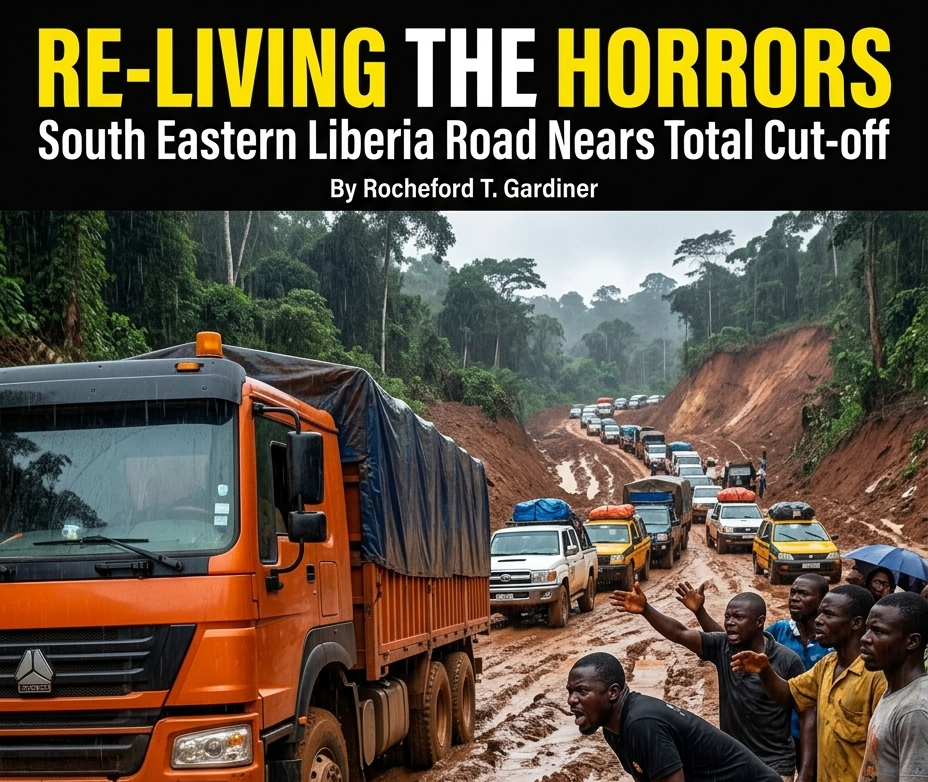
By Rocheford T. Gardiner
Despite months of persistent media warnings forecasting the eventual collapse of the highway near the Grand Gedeh–River Gee boundary, it has become painfully clear that the Ministry of Public Works had no contingency plan for southeastern Liberia. The latest field reports paint a grim picture: a vital economic artery is now on the verge of a total cut-off.
For years, I have repeatedly reported that the road rehabilitation interventions launched at the inception of the Joseph Boakai administration completely bypassed this critical stretch. The neglected segment spans from the Sapo National Park checkpoint in Grand Gedeh County to Kaylipoe Kahnweaken (Small Kahnweaken) in River Gee County. Ironically, the only entity that stepped in to rehabilitate this stretch was Euro Logging Company, which operates near the town of Duoh in Grand Gedeh.
Lately, the official narrative echoing out of Monrovia has been steeped in triumphant hype—claims that the roads are perfectly pliable and that “small cars can make it.” For nearly two years, that was actually true. Tiny sedan cars could remarkably make the journey from Monrovia all the way to Maryland County, traversing Nimba, Grand Gedeh, and River Gee.


But progress is fragile, and reverting to a crisis is terrifyingly easy.
Having tasted the relief of decent transit, the population now faces the crushing psychological and economic blow of slipping backward. It took years to crawl out of the mud of the transport crisis three years ago; it has taken mere weeks of government neglect to drag the region right back to the brink of that same misery.
Unfortunately, the Ministry of Public Works either rested on its laurels or suffered a complete breakdown in communication with its local engineers. In either case, the Ministry must own up to a costly gamble. It appears officials gambled that asphalt pavement works between Small Kahnweaken and Duoh would commence before Euro Logging’s improvised culverts and makeshift patches inevitably collapsed.
Mother Nature, however, has a brutal way of exposing administrative shortcuts.
Worse still, Public Works Minister Roland Giddings remains either partially or profoundly misinformed about the ground reality. State-owned media, like ELBC, continue to cherry-pick data and “manage” the narrative for reasons best known to themselves. Just yesterday, the station aired an interview with an individual—purportedly a clergyman—testifying to how immaculate the road conditions were and how quickly he traveled from River Gee to Monrovia.
But the unvarnished reality on the ground tells a radically different story.
The border stretch is currently a graveyard of stranded vehicles: heavily loaded trucks dug deep into the mire, bogged-down Toyota Land Cruisers, and commercial pickups trapped in the mud. Alongside the stalled vehicles are long queues on both sides, of exhausted, furious drivers and passengers. The air is thick with frustration, as stranded citizens hurl curses at President Boakai and his administration, using four-lettered words too profane to publish her.


My question; “So what became of the resources allotted for the rehabilitation of the stretch in question?”
As the seasonal rains pour their regular deluge over the southeast, a familiar dread is setting in. Slipping back into this logistical abyss means residents must once again adjust to skyrocketing commodity prices, extreme travel nightmares, and isolation.
After a brief window of relief, the Southeast is being forced to relive old horrors, leaving citizens to ask the same agonizing question: why is this region so chronically neglected?

When will this problem be solved, once and for all?