
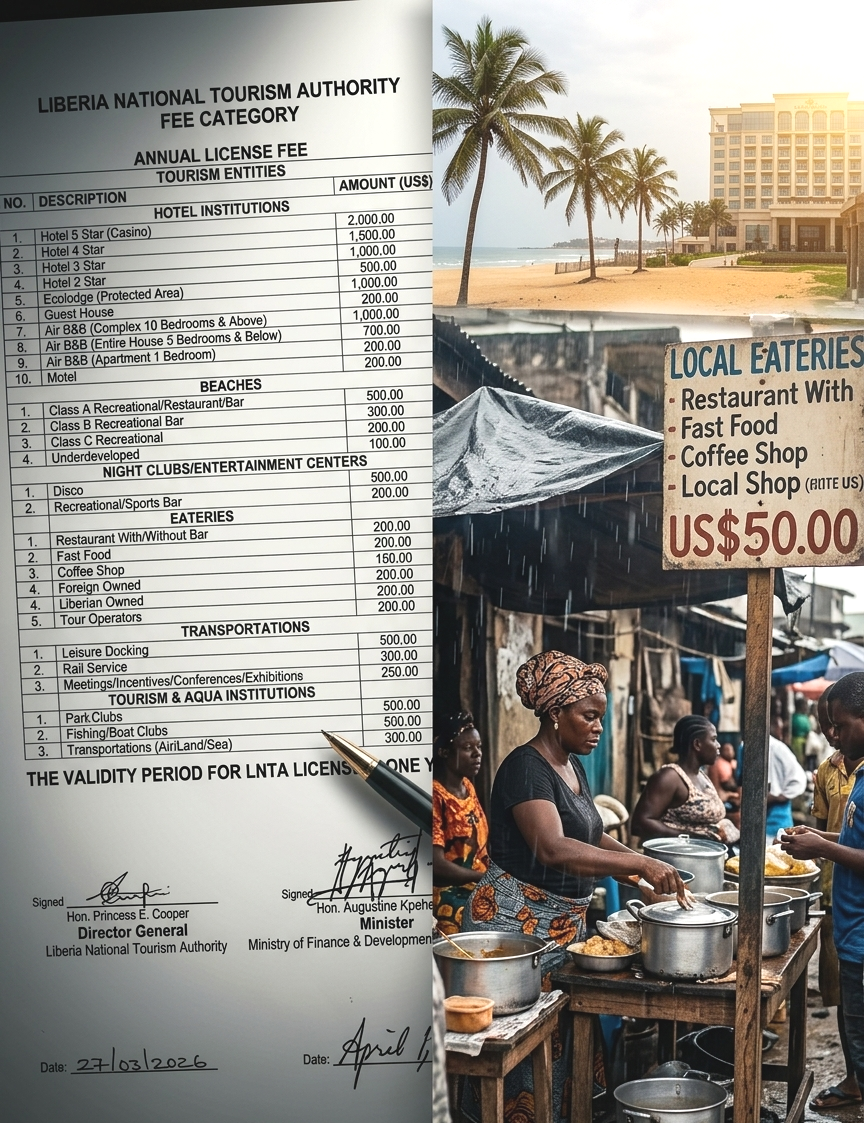
MONROVIA – The Liberia National Tourism Authority (LNTA) has ignited a firestorm of public criticism following the unveiling of a comprehensive new annual license fee structure. Signed by Director General Hon. Princess E. Cooper and Minister of Finance Hon. Augustine Kpehe Ngafuan, the mandate—effective April 2026—targets everything from five-star luxury resorts to the country’s burgeoning community of “content creators” and street-level entertainers.
The policy comes at a time when many Liberians are grappling with severe economic hardship, leading critics to describe the move as an “unfiltered tax on creativity” in a nation where the tourism infrastructure remains largely skeletal.
The Cost of Doing Business: A Breakdown
The new fee regime is exhaustive, categorizing entities into tiered brackets that reflect the LNTA’s ambitious revenue goals:
- Hospitality Giants: 5-star hotels with casinos lead the pack at US$2,000, while 3-star establishments must pay US$1,000.
- The “Airbnb” Era: Recognizing the shift in travel, large complexes (10+ bedrooms) are charged US$1,000, while single-bedroom apartments are taxed at US$200.
- The Creative “Crush”: In a move that has particularly angered the youth, commercial content creators are now required to pay US$50, while individual musicians, actors, and dancers face a US$25 annual fee.
- Local Eateries: Even small “cook shops” serving more than five dishes are not exempt, facing a US$50 levy.
Global Context: How Does Liberia Stack Up?
To understand the public’s frustration, one must look at how these fees compare to established tourism hubs like The Gambia and Jamaica. While the dollar amounts in Liberia may seem comparable on paper, the “value for money” proposition is where the gap widens.
| Feature | Liberia (LNTA 2026) | The Gambia | Jamaica |
| Industry Maturity | Emerging/Underdeveloped | Highly Established | Global Leader |
| Govt. Support | Limited infrastructure; lacks IP protection for creatives. | High investment in “Quality Assurance” and marketing. | Massive budget (approx. US$100M+) for sector promotion. |
| Typical High-End Fee | US$2,000 (5-Star Hotel) | Approx. US$1,500 – US$3,000* | Tiered; heavily subsidized for small operators. |
| Creative Tax | US$25 – US$50 (Artists/Creators) | No direct “creative license” for individuals. | Incentives for “Cultural Enterprises.” |
Note: In The Gambia and Jamaica, licensing fees are often bundled with tangible benefits like international marketing, safety certifications, and access to low-interest tourism loans.
In The Gambia, known as “The Smiling Coast,” the government recently announced a US$200 million hospitality development project. Investors and operators there view fees as a contribution to a well-oiled machine that brings in millions of European tourists. Similarly, Jamaica has allocated over US$100 million for its 2025/2026 tourism budget to enhance efficiency and marketing.
In contrast, Liberian stakeholders argue that the LNTA is “harvesting before planting.” Comedian Rose Alice Ahmar and other industry leaders have pointed out that digital creators in Liberia receive no royalties or state protection, making a US$50 “content creator” fee feel like a penalty for self-employment.
Public Reaction: “Taxing the Struggle”
The backlash across social media and in the streets of Monrovia has been swift. “We promote Liberia for free every time we post,” argued one local influencer. “Other countries pay their influencers to show off their beauty; here, the government wants us to pay them for the privilege of helping them.”
The LNTA maintains that these fees are necessary to “standardize and formalize” the sector, promising that the revenue will eventually lead to better service quality and safety. However, without a clear roadmap for reinvestment into the roads, electricity, and security that tourism requires, the “New Fees” remain a bitter pill for a population already stretched to its financial limit.
As the April enforcement deadline looms, the question remains: Will these fees build a world-class tourism industry, or will they stifle the very sparks of creativity trying to ignite it?