
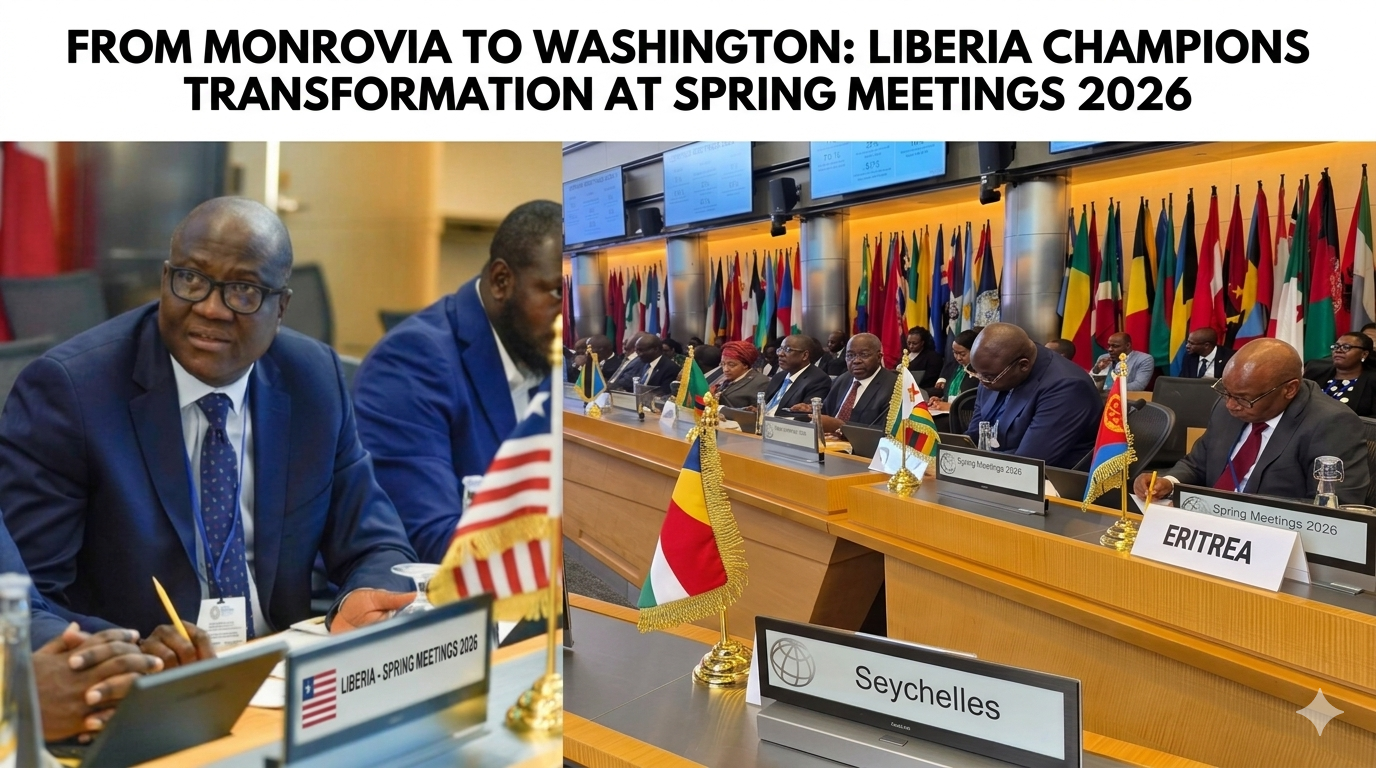
Minister Ngafuan and Governor Saamoi Lead High-Level Delegation to Secure Infrastructure Funding and Macroeconomic Stability
From our international contributors
WASHINGTON, D.C. — As the 2026 IMF and World Bank Spring Meetings drew to a close this weekend, Liberia emerged as a pivotal voice for West African economic interests. Representing the nation with diplomatic precision, Minister of Finance and Development Planning Augustine Kpehe Ngafuan and Central Bank of Liberia (CBL) Executive Governor Henry F. Saamoi engaged in a marathon of high-stakes negotiations aimed at pivoting the national economy toward sustainable growth.
At the heart of the delegation’s mission was the World Bank African Constituency Group 1 Meeting, where Finance Ministers and Central Bank Governors from across the continent gathered to deliberate on “Policies to Transform African Economies.” The Liberian representatives utilized this forum to align domestic priorities with international fiscal support frameworks.
“Our participation here is not merely about seeking aid; it is about establishing partnerships that recognize Liberia’s strategic role in regional stability and its commitment to the ARREST Agenda,” Minister Ngafuan stated during a sideline briefing.


Driving the ARREST Agenda
A primary focus of the discussions was the mobilization of resources for the Boakai administration’s ARREST Agenda—an acronym representing the administration’s core pillars:
Agriculture, Roads, Rule of Law, Education, Sanitation and Tourism.
Specifically, the Liberian team held bilateral sessions regarding the financing of the Gbarnga-Mendikorma Road Project, a critical artery intended to boost cross-border trade and agricultural productivity.
Monetary Stability and Financial Inclusion
Executive Governor Henry F. Saamoi led the monetary policy dialogue, emphasizing the CBL’s success in stabilizing the Liberian Dollar and curbing inflation over the previous fiscal year. Saamoi’s engagement with IMF leadership focused on:
- Strengthening foreign exchange reserves.
- Modernizing the payment system to enhance financial inclusion.
- Transforming the informal sector through digital infrastructure.
A Unified Front for Debt Reform
The Africa Group 1 Constituency, comprising 22 nations, collectively called for a more robust international response to debt vulnerabilities. The group argued that for economies like Liberia’s to truly transform, there must be a shift toward long-term, low-interest financing that accounts for climate resilience and the unique challenges faced by post-conflict nations.
Observers noted that the “ably represented” Liberian delegation succeeded in restoring a sense of predictability to the country’s economic outlook. By presenting a unified front between the Ministry of Finance and the Central Bank, Liberia signaled to international investors and multilateral partners that its fiscal and monetary policies are operating in concert.
Looking Ahead
As the delegation prepares to return to Monrovia, the focus will shift to implementing the technical agreements reached in Washington. With the World Bank signaling increased support for the “Mission 300” energy initiative, Liberia is positioned to benefit from regional projects aimed at expanding electricity access—a prerequisite for the industrialization goals discussed during the summit.