
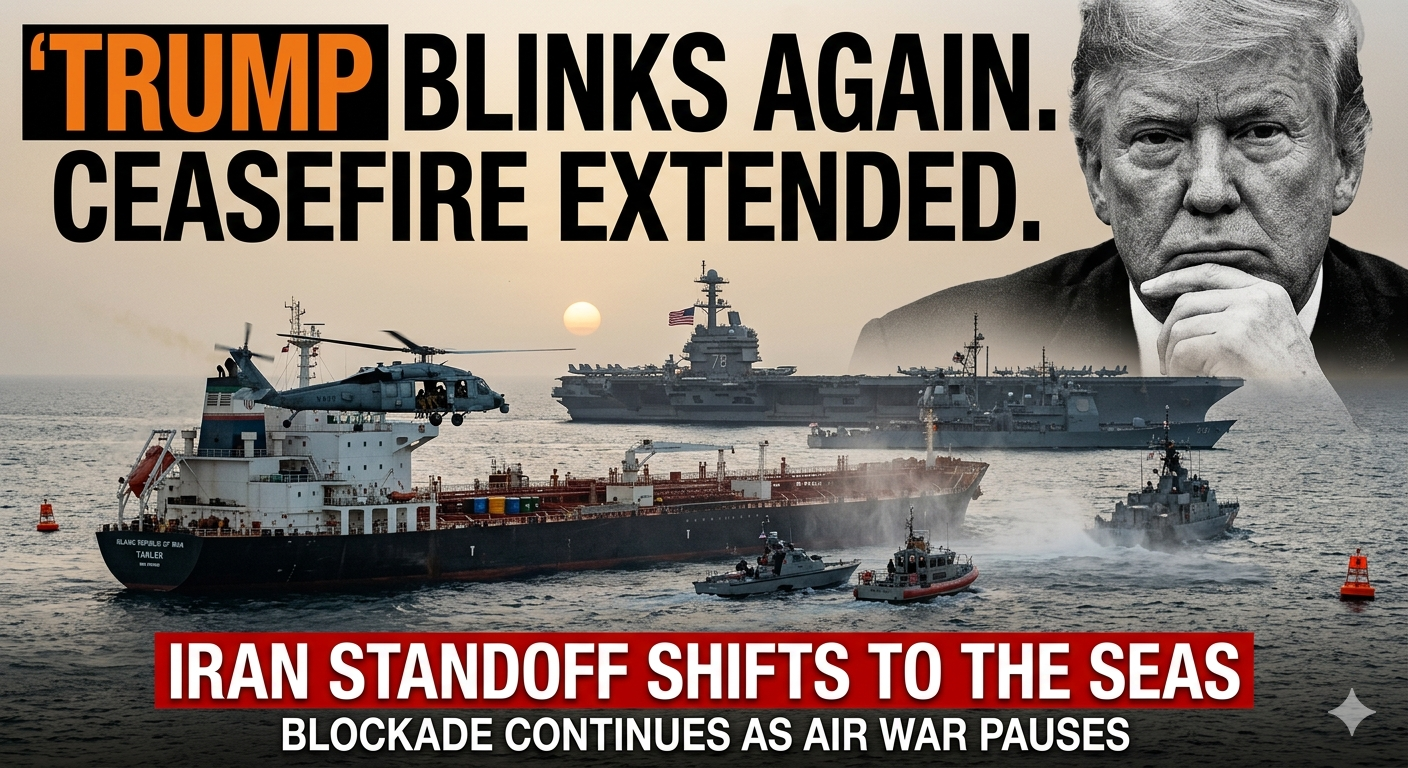
WASHINGTON, D.C. — In a dramatic reversal of his “fire and fury” rhetoric, President Donald Trump announced late Tuesday that he is indefinitely extending the ceasefire with Iran, backing away from threats of a massive bombing campaign for the second time in two weeks.
The decision, which came just hours before a midnight deadline, has temporarily averted a return to full-scale kinetic warfare but has done little to ease the suffocating economic and maritime tensions paralyzing the region.
A Retreat from the Brink
President Trump’s shift follows a week of escalating threats in which he warned that “lots of bombs” would “start going off” if Tehran did not return to the negotiating table with a “unified proposal.” However, citing a personal request from Pakistani Prime Minister Shehbaz Sharif and Field Marshal Asim Munir, Trump pivoted to a more cautious stance.
“Upon the request of the leadership of Pakistan, we have been asked to hold our attack,” Trump posted on Truth Social. “I have directed our Military to continue the Blockade but remain ready and able… we will extend the Ceasefire until such time as their proposal is submitted.”
The move marks the second time this month that the administration has paused planned strikes at the eleventh hour, a pattern that critics label as “erratic” and supporters call “strategic patience.”
The Islamabad Impasse
While Washington expressed hope for a “Grand Deal,” the diplomatic track in Islamabad is currently stalled. Vice President J.D. Vance, who was slated to lead the U.S. delegation to Pakistan, has officially postponed his trip.
The primary sticking point? The blockade. Iranian officials have grown increasingly recalcitrant, showing a marked lack of interest in further meetings while U.S. Navy assets continue to choke off Iranian commerce.
- Tehran’s Demands: Iran refuses to send a delegation to Islamabad until the U.S. lifts its naval blockade on Iranian ports and ceases the seizure of Iranian-flagged vessels.
- The U.S. Position: The White House maintains that the blockade is “non-negotiable” until Iran agrees to a permanent dismantling of its nuclear infrastructure and a cessation of regional proxy activity.
Chaos in the Strait of Hormuz
As the air war pauses, the “Tanker War” of 2026 is heating up. Despite the ceasefire, the situation in the Strait of Hormuz remains volatile. Global energy markets are on edge following reports of fresh attacks:
- Naval Interceptions: The U.S. Navy recently intercepted an Iranian tanker attempting to breach the blockade in the Gulf of Oman, an act Tehran has denounced as “state-sponsored piracy.”
- Maritime Guerrilla Warfare: Reports emerged Wednesday of three separate attacks on commercial shipping off the Iranian coast, suspected to be the work of IRGC fast-attack boats.
- Global Shockwaves: Nearly 20% of the world’s oil and gas is currently stalled or diverted. European nations have begun prepping emergency energy response plans as jet fuel shortages loom across the continent.
What’s Next?
The Middle East remains in a state of “frozen conflict.” While the bombs have stopped falling for now, the economic siege of Iran is intensifying. Sources within the administration suggest that Trump’s son-in-law, Jared Kushner, and Special Envoy Steve Witkoff are currently consulting in Washington to draft a “take-it-or-leave-it” peace framework.
Whether Tehran—fractured by internal political strife and a crippled economy—will blink before the next U.S. deadline remains the trillion-dollar question for the global economy.
