
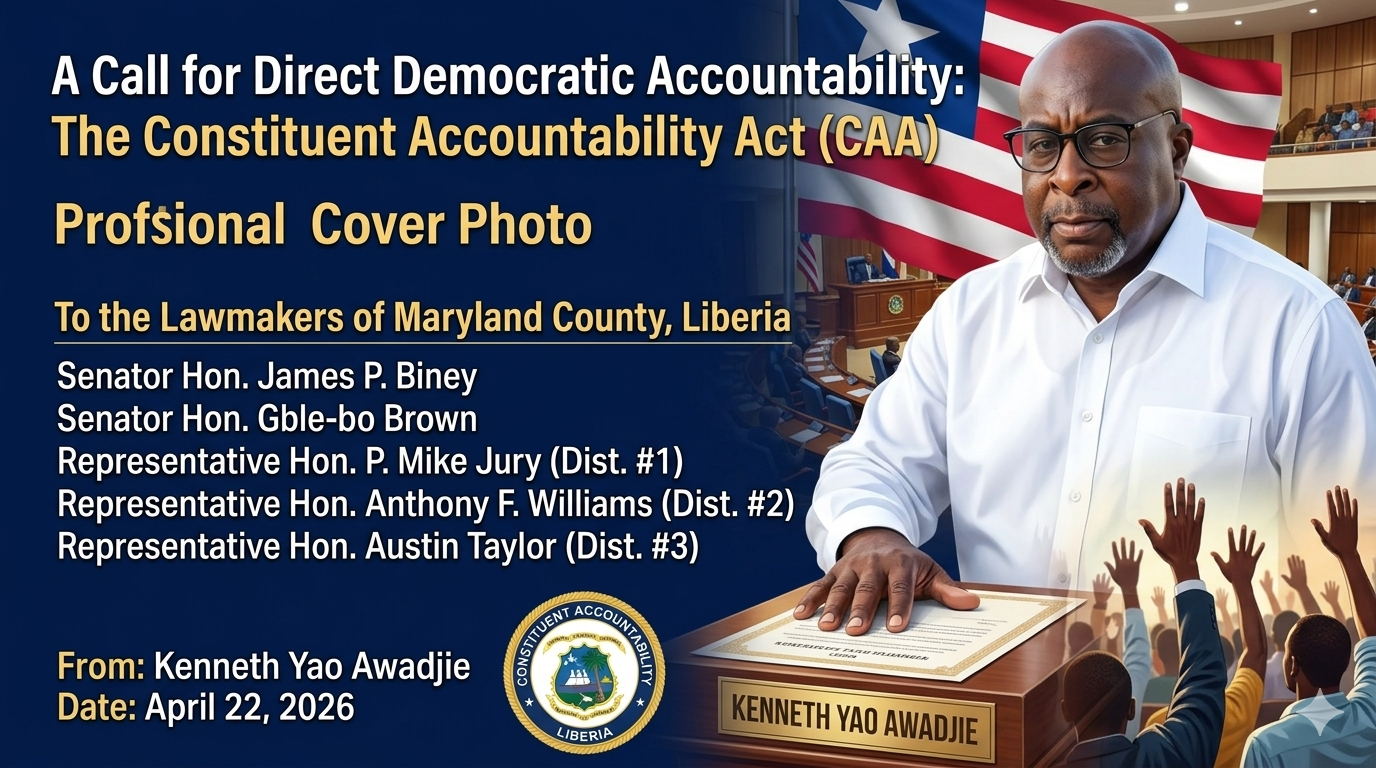
To the Lawmakers of Maryland County:
- Senator Hon. James P. Biney
- Senator Hon. Gble-bo Brown
- Representative Hon. P. Mike Jury (Dist. #1)
- Representative Hon. Anthony F. Williams (Dist. #2)
- Representative Hon. Austin Taylor (Dist. #3)
From: Kenneth Yao Awadjie Date: April 22, 2026
This proposal is my contribution to the democracy of our nation, Liberia. I am issuing this call to every Liberian who wishes to see a more vibrant and beautiful democracy—specifically to our elected leaders. I have drafted the following bill to redefine the relationship between the people and their representatives, ensuring that the power to remove a lawmaker remains where it belongs: with the voters.
DRAFT BILL: THE CONSTITUENT ACCOUNTABILITY ACT (CAA)
AN ACT to redefine the primary accountability of elected representatives to their constituents; to establish constituent-led recall and censure mechanisms; and to limit the power of parliamentary bodies to expel members for reasons other than legal incapacity or criminal conviction.
WHEREAS the foundation of a democratic republic is the sovereignty of the people; WHEREAS Members of the Legislature of the Republic of Liberia are elected by and serve as the voice of their constituents; WHEREAS accountability should flow directly to the electorate, not solely to legislative peers; and WHEREAS the power of expulsion by a legislative majority can undermine electoral mandates and distort local representation;
BE IT ENACTED by the Senate and House of Representatives of the Republic of Liberia in Legislature Assembled, under the doctrine of a Referendum in this 55th Legislative Assembly:
Section 1: Short Title
This Act shall be cited as The Constituent Accountability Act (CAA).
Section 2: Principle of Direct Accountability
A Member of the Legislature (a Legislator) holds their mandate by virtue of election by the registered voters of their constituency. Their primary and ultimate accountability is to said constituents.
Section 3: Limitation on Parliamentary Expulsion
- The power of either House of the Legislature to expel one of its members is hereby restricted.
- Expulsion by a vote of the House may only be exercised on the following grounds:
- (a) Final conviction for a serious criminal offense adjudicated by a competent court or sanctioned by the Supreme Court of Liberia.
- (b) A final ruling by a competent court or the National Elections Commission (NEC) that the member was ineligible to stand for election at the time of their seating.
- (c) A sustained finding of a serious breach of security protocols that directly endangers the safety of the Chamber.
- Penalties for Rule Violations: A legislator found violating the rules of the House shall be penalized with measures no greater than suspension and the forfeiture of legislative amenities. Such members must issue a formal apology to their constituency, published in at least four (4) national dailies and on their personal social media platforms.
- Prohibited Grounds: Expulsion for reasons of political disagreement, voting records, party affiliation, or “conduct unbecoming” (that is not otherwise unlawful) shall not be permitted.
Section 4: Establishment of Constituent Recall Procedure
- A formal Constituent Recall Process is hereby established.
- Upon a petition signed by not less than 25% of the registered voters of a constituency, a Recall Referendum shall be triggered.
- The ballot shall ask: “Shall [Senator/Representative Name] be recalled from office?”
- If a majority votes “Yes,” the seat shall be declared vacant and a by-election held forthwith. The recalled member shall be eligible to stand in said by-election.
- No recall petition may be initiated within the first 12 months of a member’s term or within 12 months of a general election.
Section 5: Parliamentary Censure vs. Constituent Notification
- The Houses of Legislature retain the power to censure a member for misconduct.
- Any motion of censure must, within seven days, be formally communicated by the Clerk of the House to local authorities and major media outlets within the member’s constituency.
- The censured member shall have the right to include a personal statement of response in said communication.
Section 6: Impeachment
This Act does not alter the constitutional process for the impeachment of the Head of State or Ministers, which remains distinct from legislative expulsion.
Section 7: Consequential Amendments
- Relevant Standing Orders of the Legislature are hereby amended to conform with this Act.
- Any prior legislation regarding legislative conduct shall be read subject to the provisions of this Act.
Explanatory Notes & Rationale
- Inverting the Model: Instead of Legislators being ultimately accountable to party whips and peers, the “police” of a legislator’s conduct becomes their own electorate.
- Preventing Partisan Purges: This stops majority parties from using expulsion as a tool to silence dissenting voices or remove minority-party members for partisan advantage.
- Democratic Reinforcement: A legislator who disagrees with their party but retains the support of their people can remain in office.
- Transparency: The censure notification process ensures that constituents are informed of official judgments, allowing them to make an informed decision at the ballot box.
Final Statement: It is the moral right of the citizens of Liberia to stand in the sun and rain to vote for their choice. It is therefore imperative that Legislators remain answerable to those constituents, and not merely to their “peers.”
Prepared by: Kenneth Yao Awadjie April 22, 2026
