
By Rocheford T. Gardiner
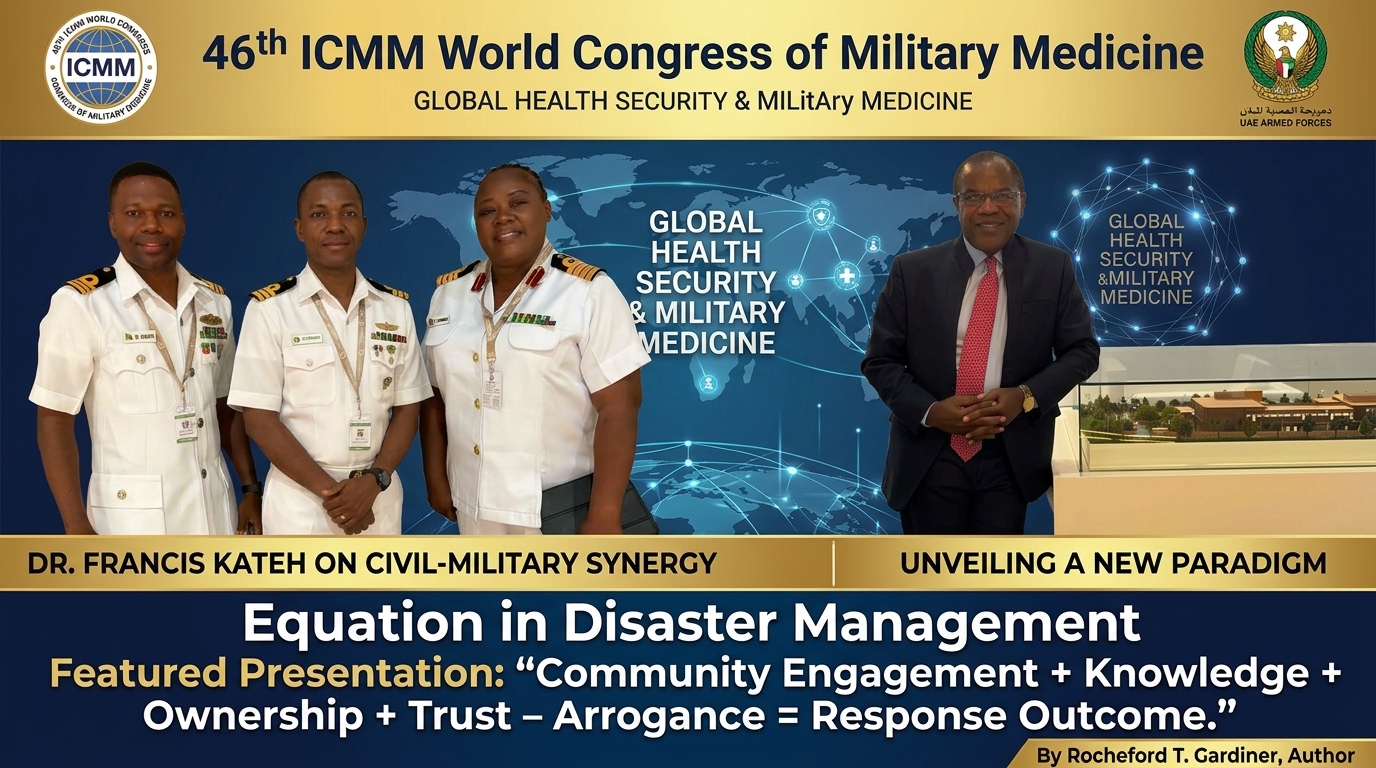
ABU DHABI, United Arab Emirates — Dr. Francis Nah Kateh, Liberia’s internationally acclaimed former Deputy Minister of Health and Chief Medical Officer, has introduced a practical framework for crisis and outbreak response at the 46th International Committee of Military Medicine (ICMM) World Congress of Military Medicine, encapsulating decades of frontline public health leadership into a single formula: “Community Engagement + Knowledge + Ownership + Trust – Arrogance = Response Outcome.”
Addressing military medical commanders, global health policymakers, and emergency response specialists gathered at the ADNEC Centre in Abu Dhabi for the November 9–13, 2026 congress, Dr. Kateh emphasized that the success or failure of any humanitarian or epidemic intervention is determined long before the first medical deployment—and depends heavily on how institutions interact with affected populations.
Breaking Down the Response Equation

Speaking during the congress’s high-level keynote panel, “Preparing for Future Pandemics: Lessons from the Past,” Dr. Kateh—who currently serves as Director at Areem Plus Global Consultancies—drew directly from Liberia’s hard-won experience battling the 2014–2016 West African Ebola epidemic as well as the COVID-19 pandemic.
According to Dr. Kateh, technical expertise and military logistics alone cannot contain a public health emergency if human dynamics are ignored:
- Community Engagement: Effective surveillance, contact tracing, and containment begin at the grassroots level. Communities must be treated as active partners rather than passive recipients of directives.
- Knowledge: Clear, culturally accurate, and timely communication equips citizens to protect themselves and counters misinformation before it spreads faster than the pathogen.
- Ownership: When local leaders, traditional authorities, and everyday citizens take ownership of public health measures, compliance shifts from enforced mandate to shared civic responsibility.
- Trust: Trust between citizens, civilian health authorities, and uniformed medical personnel serves as the essential currency of any emergency response.
- Minus Arrogance: Dr. Kateh underscored that top-down institutional arrogance—dismissing local customs, ignoring community concerns, or imposing rigid protocols without dialogue—actively subtracts from response capacity and breeds resistance.
“You can have the best laboratories, the strongest logistics, and the most advanced medical teams in the world, but if you subtract arrogance from the equation, that is when the real response outcome begins to turn in your favor,” the framework illustrates.
Global Perspectives on Civil-Military Health Readiness


Moderated by Dr. Maha Barakat, the keynote session placed Dr. Kateh alongside prominent global health veterans who led national responses to major infectious disease threats, including former Indonesian Minister of Health H.E. Budi Gunadi Sadikin, Uganda’s Ministry of Health Permanent Secretary Dr. Diana Atwine Kanzira, and Mr. Rajeev Sadanandan of the World Bank’s Pandemic Fund Technical Advisory Panel.
Hosted under the patronage of the UAE leadership and organized by the UAE Armed Forces Medical Services, the 46th ICMM World Congress brings together delegates from over 100 nations to strengthen civil-military interoperability, humanitarian medicine, and global health security.
For Liberia and the broader West African sub-region, Dr. Kateh’s presentation in Abu Dhabi reinforces how frontline lessons forged in Monrovia, Harper, and rural counties across the country continue to shape international doctrine on pandemic preparedness and disaster management.

Marylanders and Liberians are good at what they do. Keep making Liberia proud, sir.