
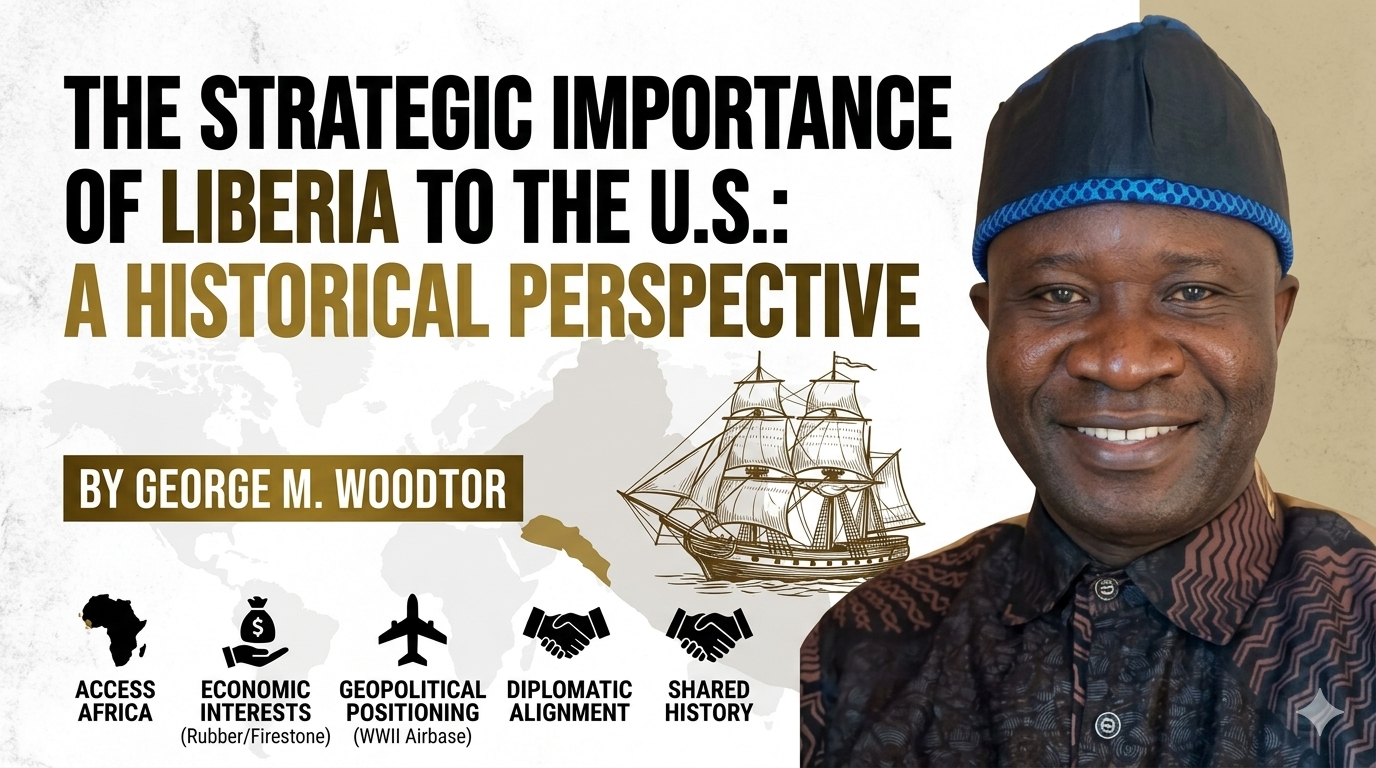
By George M. Woodtor
Pennsylvania, USA
Tel.: +1 484 943 1396
Liberia, initially known as the “Grain Coast” during the 1800s, is a small but historically significant nation on the West Coast of Africa. It is bordered by Sierra Leone to the west, Guinea to the north, and Côte d’Ivoire to the east. Its capital, Monrovia—named in honor of the fifth U.S. President, James Monroe—sits prominently along the Atlantic coast.
As the first independent nation on the African continent and the second-oldest Black republic in the world, Liberia gained its independence on July 26, 1847. The nation’s foundations were laid by the United States through the American Colonization Society (ACS), established in 1816.
The strategic importance of Liberia to the United States, viewed through a historical lens, can be measured by several key pillars:
A Conduit to Africa
In the early 19th century, the U.S., via the ACS, established the colony of Liberia (1822) as a primary gateway to the African continent. This was intended not only as a settlement for free people of color but also as a strategic outpost for American trade and influence in the region.

Economic Interests and Natural Resources
In 1926, Harvey Firestone established the Firestone Tire and Rubber Company in Liberia to secure a U.S.-controlled source of natural rubber, successfully breaking the British and Dutch monopolies in Southeast Asia. Supported by the U.S. government, this venture involved a 99-year lease of over one million acres, resulting in the world’s largest contiguous rubber plantation (Harbel). This partnership became a vital component of the American industrial economy.
Strategic and Geopolitical Positioning
Liberia has historically served as a cornerstone of U.S. interests in West Africa, hosting essential military and communication facilities. During World War II, the United States constructed Roberts International Airport (RIA) as a critical strategic airbase. The facility was indispensable for refueling Allied aircraft, patrolling the Atlantic against German U-boats, and securing rubber supplies essential to the war effort.
Diplomatic Alignment
Historically, Liberia has been a steadfast diplomatic ally. The nation has frequently aligned its votes in the United Nations General Assembly with U.S. positions, providing consistent support on key international issues, including those regarding the State of Israel.
Shared History and Institutional Influence
Founded by Americo-Liberians, the country shares deep cultural and institutional ties with the United States. Often viewed as a “sister republic,” Liberia has served as a laboratory for democratic and social development in Africa. Much of Liberia’s national identity mirrors the American model: its Constitution, tripartite government structure, flag, pledge of allegiance, and corporate frameworks were all designed in the image of the United States.
To be continued.