
by Rocheford T. Gardiner
Special Report from Harper, Maryland County
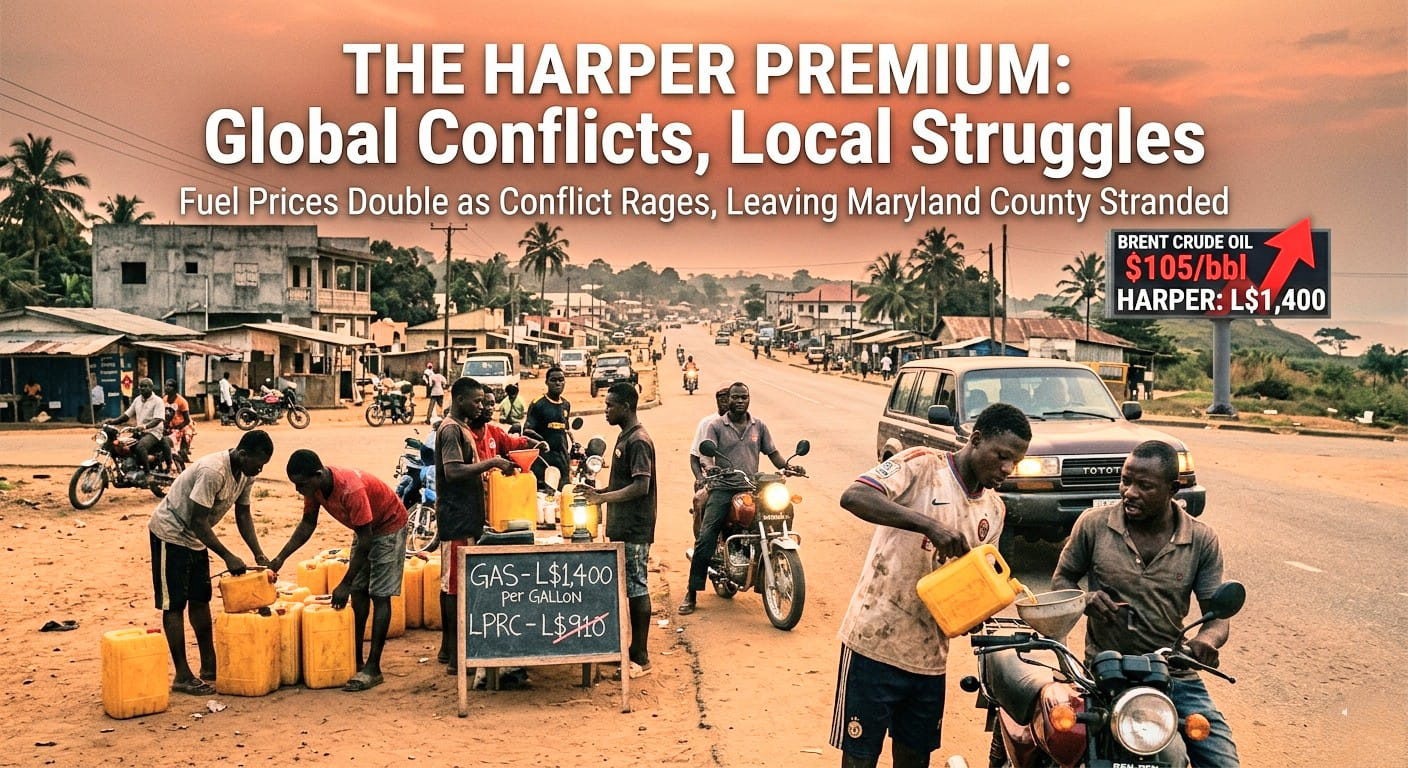
While the global community watches the escalating conflict involving Iran with an eye on the Strait of Hormuz, residents of Harper are feeling the heat of the battlefield at the fuel pump. In a staggering 75% jump that has outpaced official government projections, the price of gasoline in Maryland County has reached a record high of L$1,400 per gallon since the democratic removal of President George Weah, leaving the region’s economy in a state of “silent panic.”
The Global-to-Local Pipeline
The math behind the crisis is as simple as it is brutal. As of mid-March 2026, Brent crude—the global benchmark—has surged past $105 per barrel due to the disruption of tanker traffic in the Middle East. Because Liberia is 100% dependent on imported petroleum, these international shocks are transmitted almost instantly to the streets of Monrovia.
However, the “Harper Premium” adds a second layer of hardship. While the Ministry of Commerce and the Liberia Petroleum Refining Company (LPRC) issued a price circular on March 14 setting the national retail price at L$910, that figure remains a distant dream for Marylanders.
Analysis: Why the L$500 Discrepancy?
The gap between the official L910 and the L1,400 being paid in Harper is driven by three critical factors:
Supply Chain Exhaustion: Harper sits at the terminus of a long, often difficult supply route from Monrovia. Transporting fuel via the “Southeastern Corridor” during periods of global scarcity allows distributors to price in the “risk of the road.”
The “Can-Boy” Monopoly:

As major gas stations in Harper hit their reserve limits or close early to manage stock, the informal market—the “can-boys”—become the only source of fuel. This secondary market operates without price ceilings, effectively hiking rates the moment the sun goes down.
Speculative Hoarding: Local vendors, fearing that the Iran conflict will lead to a total blockade of global shipping, are reportedly holding onto stock or raising prices prematurely to ensure they can afford the next shipment at even higher international rates.
The Economic Ripple Effect
For the average professional in Harper, the impact is multi-dimensional:
Commuting: For those traveling the Harper-to-Pleebo route or long-distance to Zwedru, fuel costs have effectively doubled in less than a week.
Technical Operations: The cost of running generators for IT work or professional photography editing is now eating into 40% of standard profit margins.
Cost of Living: As fuel prices rise, the cost of transporting fish and farm produce from the interior to the Harper market is expected to follow, threatening food security for the county’s most vulnerable.
The Outlook
The LPRC has activated a “contingency framework” to prevent artificial shortages, but for the people of Maryland County, the framework feels insufficient. Unless there is a de-escalation in the Middle East or a localized subsidy for the Southeastern region, the L$1,400 gallon may become the new normal.
For now, the residents of Cape Palmas are left to wonder: how much longer can a local economy run on “empty”?