
by Rocheford T. Gardiner
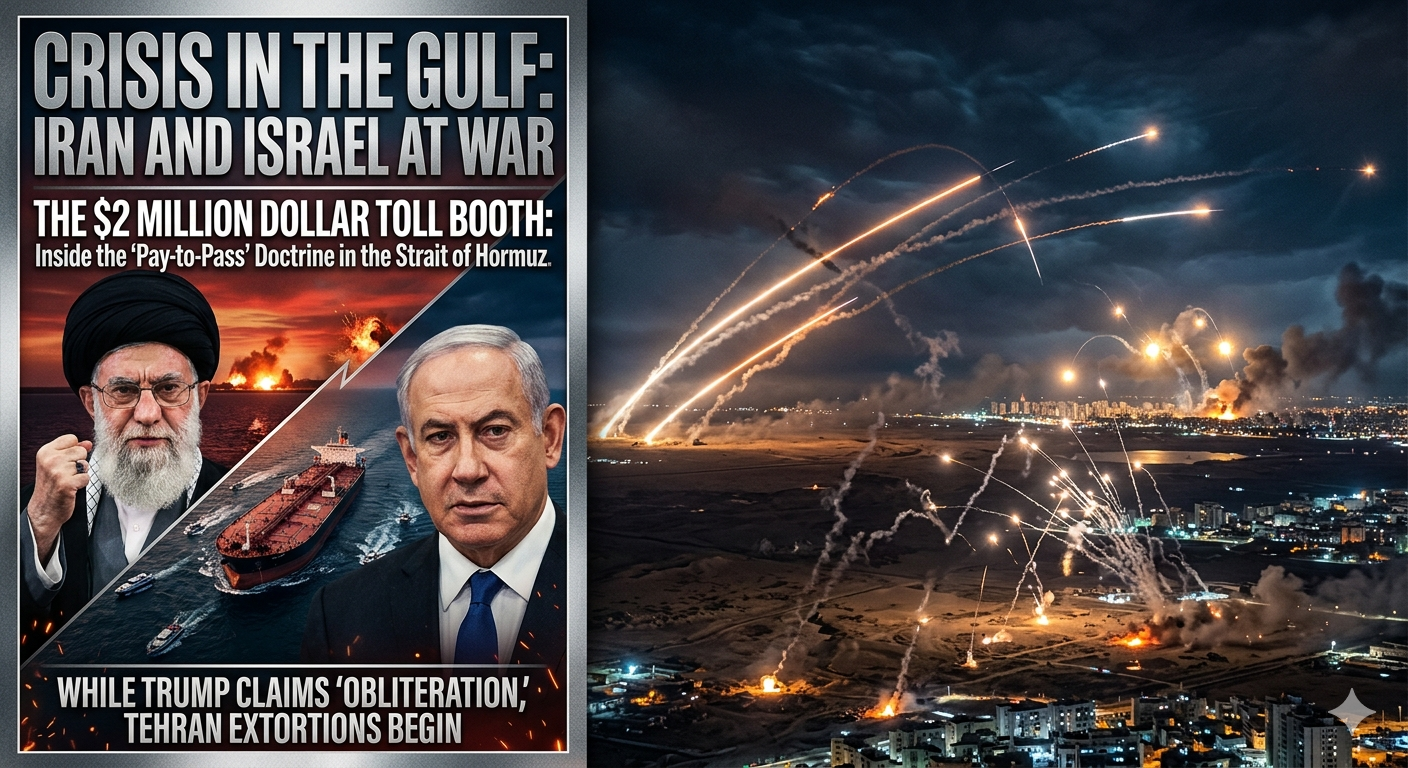
TEHRAN / WASHINGTON — The Middle East stands at a knife-edge as the “2026 Iran War” enters its fourth week. Despite claims from Mar-a-Lago of a total military victory, the Islamic Republic has effectively monetized the world’s most vital maritime chokepoint, charging shipping companies millions for “safe passage” while denying that any ceasefire negotiations are underway.
The “Pay-to-Pass” Doctrine
In a move that has sent shockwaves through global markets, Tehran has transitioned from a total blockade of the Strait of Hormuz to a selective, high-priced transit system. Iranian lawmaker Alaeddin Boroujerdi confirmed Sunday that the regime is now charging certain vessels a $2 million “transit fee” to navigate the waterway.
Describing the toll as a “new concept of sovereignty,” Boroujerdi framed the charges as a reflection of Iran’s enduring strength despite weeks of U.S. and Israeli airstrikes. While some vessels from “friendly” nations—including Indian-flagged LPG carriers—have reportedly been granted passage after diplomatic coordination, others are being forced to pay the multi-million dollar fee through maritime intermediaries.
“Collecting $2 million as transit fees reflects Iran’s strength over the strategic waterway,” Boroujerdi stated on state television.


Trump: “Phase Three” is Complete
The financial audacity of the Iranian regime stands in stark contrast to the rhetoric coming from the White House. Speaking to reporters yesterday, President Donald Trump declared that Operation Epic Fury has “obliterated” the Iranian armed forces.
Trump claimed that the U.S. military has successfully “wiped out” three distinct sets of regime leadership, suggesting that the “Governing Council” intended to replace the late Supreme Leader Ali Khamenei has been neutralized.
“We’ve wiped out the leadership—phase one, phase two, and largely phase three,” Trump said, though he simultaneously alluded to “very good” talks with an unidentified “top person” in the Iranian government to end the hostilities.
The Great Denial: Rhetoric vs. Reality
The Iranian Foreign Ministry has been quick to shoot down any rumors of a ceasefire. Foreign Minister Abbas Araghchi dismissed the American claims of negotiations as a ploy to stabilize volatile energy markets.
Tehran accuses the Trump administration of using “empty rhetoric” to artificially lower global oil prices, which have seen historic volatility since the conflict began on February 28. Iranian officials insist they have not requested a ceasefire and will continue their “legitimate self-defense” as long as U.S. and Israeli strikes continue.
A Region Under Fire
While Western powers—led by the UK, France, and Germany—have refrained from joining the direct U.S.-Israeli assault, they have issued stern condemnations of Iran’s retaliatory strikes. This has sparked a furious response from Tehran, which has labeled the Western stance as “pure hypocrisy,” pointing out that these nations remain silent on the initial strikes that killed Iranian leadership.
The human and economic cost continues to mount across the Gulf Cooperation Council (GCC) states:
- Saudi Arabia & UAE: Both nations have intercepted hundreds of drones and missiles. Strikes have targeted the Ras Tanura refinery and areas near Dubai International Airport.
- Kuwait & Qatar: Missile debris has caused fires at power stations and food warehouses, with Kuwait reporting civilian casualties from falling shrapnel.
- Energy Infrastructure: Iran has vowed that any strike on its power plants will result in the “proportional” destruction of energy and water facilities across the entire Gulf.