
by Rocheford T. Gardiner
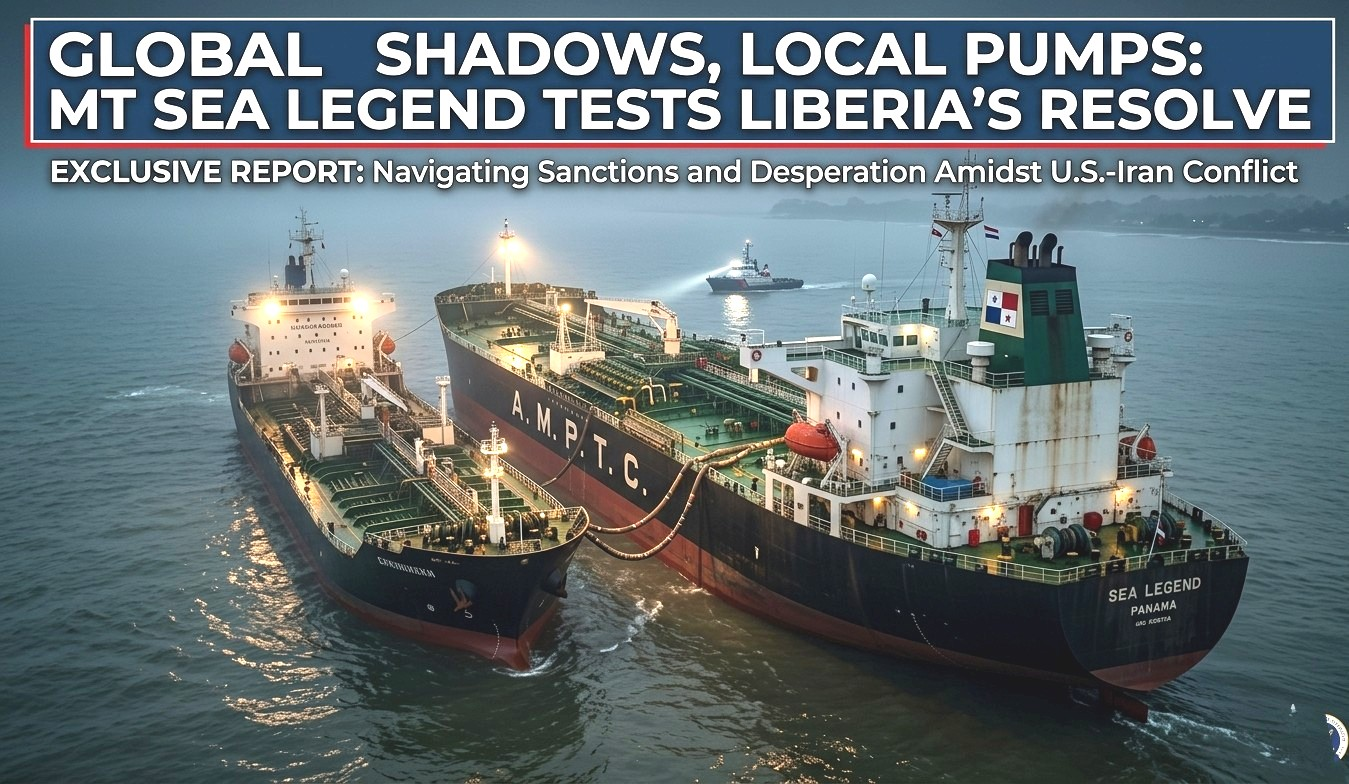
Cape Palmas, Liberia – As fuel prices across Liberia hit a staggering $6.55 per gallon for diesel, a high-stakes diplomatic and economic drama is unfolding off the West African coast. The MT Sea Legend, a tanker reportedly laden with Russian-origin diesel, is steaming toward Liberian waters, sparking a firestorm of controversy over international sanctions, national sovereignty, and the desperate need for affordable energy.
The “Ghost” Shipment
The controversy centers on a sophisticated maritime maneuver. According to shipping intelligence, the MT Sea Legend received its cargo via a ship-to-ship (STS) transfer near Dakar, Senegal, from the MT Zaphira. The orchestrator of this deal is allegedly Ferrat Navigation FZCO, a UAE-based firm recently blacklisted by the UK and EU for its role in facilitating Russian energy exports.
For Liberia, the arrival of this vessel—expected between April 7 and April 13, 2026—presents a “damned if you do, damned if you don’t” scenario.
The Washington Pivot: A Blind Eye by Necessity?

While critics in Monrovia warn that docking the ship could trigger Western “red flags,” the geopolitical landscape has shifted dramatically in recent weeks.
Sanctions Rollback: On March 12, the U.S. Office of Foreign Assets Control (OFAC) issued General License 34, a strategic move to stabilize global markets. Facing a massive energy crisis, Washington has temporarily authorized transactions involving Russian petroleum products.
The Iran Factor: The primary driver for this leniency is the escalating U.S.-Israeli conflict with Iran. With the Strait of Hormuz effectively closed and “Operation Epic Fury” dominating American military and diplomatic resources, the White House has prioritized lowering global pump prices over the strict isolation of Russian fuel.
“Washington is currently looking at the world through a very narrow lens—Tehran,” says one regional maritime analyst. “The ‘tiny detail’ of a single tanker in West Africa is unlikely to move the needle in the State Department when they are managing a full-scale war in the Middle East.”
A Nation at a Breaking Point
In Liberia, the technicalities of international law matter less than the daily struggle of the “ordinary citizen.” On April 4, the Ministry of Commerce and Industry and the Liberia Petroleum Refining Company (LPRC) announced another sharp hike in prices.
Diesel: Increased by $0.77 to $6.55/gallon.
Gasoline: Rose to $5.09/gallon.
The government cites “global oil volatility” as the culprit. If the Boakai administration blocks the MT Sea Legend, they risk further shortages and potential civil unrest. If they allow it, they rely on the hope that the U.S. remains too preoccupied with Iran to enforce secondary sanctions on a small “frontier” market.
The Road Ahead
LPRC officials have remained tight-lipped about whether the tanker will be granted clearance to discharge its cargo. However, insiders suggest that the “pragmatic” approach may prevail. With the U.S. having already issued temporary waivers for Russian oil to protect its own economy and allies, Liberia may find safety in the shadow of larger global interests.
For now, the MT Sea Legend continues its journey. Its arrival will not just bring fuel to the pumps, but will serve as a litmus test for how a small nation navigates the cracks in a fractured global order.