
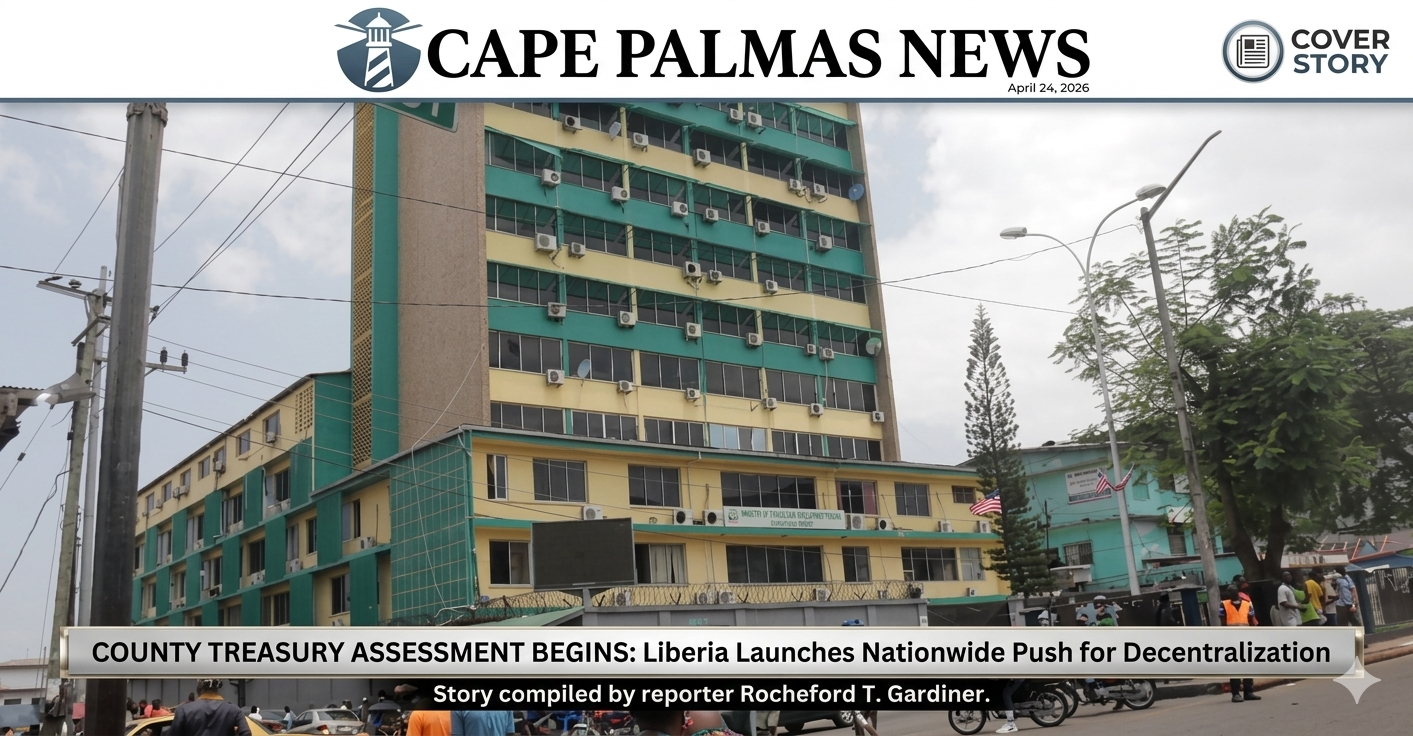
MONROVIA – In a significant move to shift financial power away from the capital, the Government of Liberia has officially begun a nationwide assessment to construct and renovate six additional county treasuries.
The initiative, led by the Ministry of Finance and Development Planning (MFDP), marks a critical milestone in the country’s journey toward a decentralized governance structure, aiming to slash bureaucracy and bring essential financial services directly to rural populations.
Phase One: On the Ground in Sinoe and Grand Kru
The assessment team kicked off the first phase of the project on April 22, focusing on Sinoe and Grand Kru counties. Local leaders in these regions have already begun identifying strategic properties to house the new facilities.
In Sinoe, a site near the telecommunications hub has been proposed, while Grand Kru officials are looking to expand the existing County Service Center to integrate treasury operations. The evaluation is set to expand this weekend, with teams heading to:
- Maryland County
- Grand Gedeh County
- Lofa County
- Bomi County
Superintendent Alexander Nah Sleweon praised the government’s commitment to the remote regions, noting that the physical presence of officials signals that development is no longer confined to Monrovia. “Traveling to this part of the country is not easy,” Sleweon remarked. “Your presence shows that development is… gradually reaching the people who need it most.”
Ending the “Monrovia Monopoly”
For years, government officials and residents in remote areas have faced the grueling task of traveling to the capital just to process basic financial transactions—a practice described as costly, time-consuming, and inefficient.
Dr. Romeo Gbartea, Director of the Fiscal Decentralization Unit at the MFDP, explained that the selection of these six counties was based on their distance from Monrovia and their current limited operational capacity.
“With the treasury system in place, ministries and agencies will be able to handle their financial activities right where they operate,” Dr. Gbartea stated.
Each new treasury will act as a “one-stop shop,” allowing local government entities to:
- Prepare financial requests locally.
- Obtain necessary approvals without travel.
- Complete revenue and payment transactions efficiently.
Building on Success
Currently, only four counties—Grand Bassa, Nimba, Margibi, and Bong—have fully functional treasury offices. The expansion comes as population growth and increased economic activity have put a strain on these existing hubs.
While full construction and renovation will take time, authorities are planning interim measures to ensure services begin shortly after the assessment concludes. This includes the finalization of operational guidelines and the deployment of trained personnel to the selected sites.
A Legal and Economic Shift
The initiative is not just about buildings; it is rooted in the Public Financial Management Law, the Revenue Sharing Law, and the Local Government Act. By decentralizing revenue collection and budget implementation, the government hopes to stimulate local economies, create jobs, and foster a more transparent and accountable financial system.
As the assessment team continues its work through April 26, the message from the MFDP remains clear: the goal is an inclusive system where no citizen is penalized by their geography.
