
by Rocheford T. Gardiner
HARPER, MARYLAND COUNTY – Normalcy returned to southeastern Liberia’s Maryland and River Gee counties late Saturday night as power was finally restored, following a grueling three-day regional blackout. The outage, which began late week, served as a stark reminder of the region’s heavy reliance on international energy partners.
The Breakdown: A Regional Ripple Effect
The darkness that engulfed the two counties was not caused by a local infrastructure failure, but rather a significant technical collapse across the border. Because Liberia lacks a fully interconnected national grid reaching its southeastern tip, Maryland and River Gee rely almost exclusively on the CLSG (Côte d’Ivoire, Liberia, Sierra Leone, and Guinea) interconnection line.
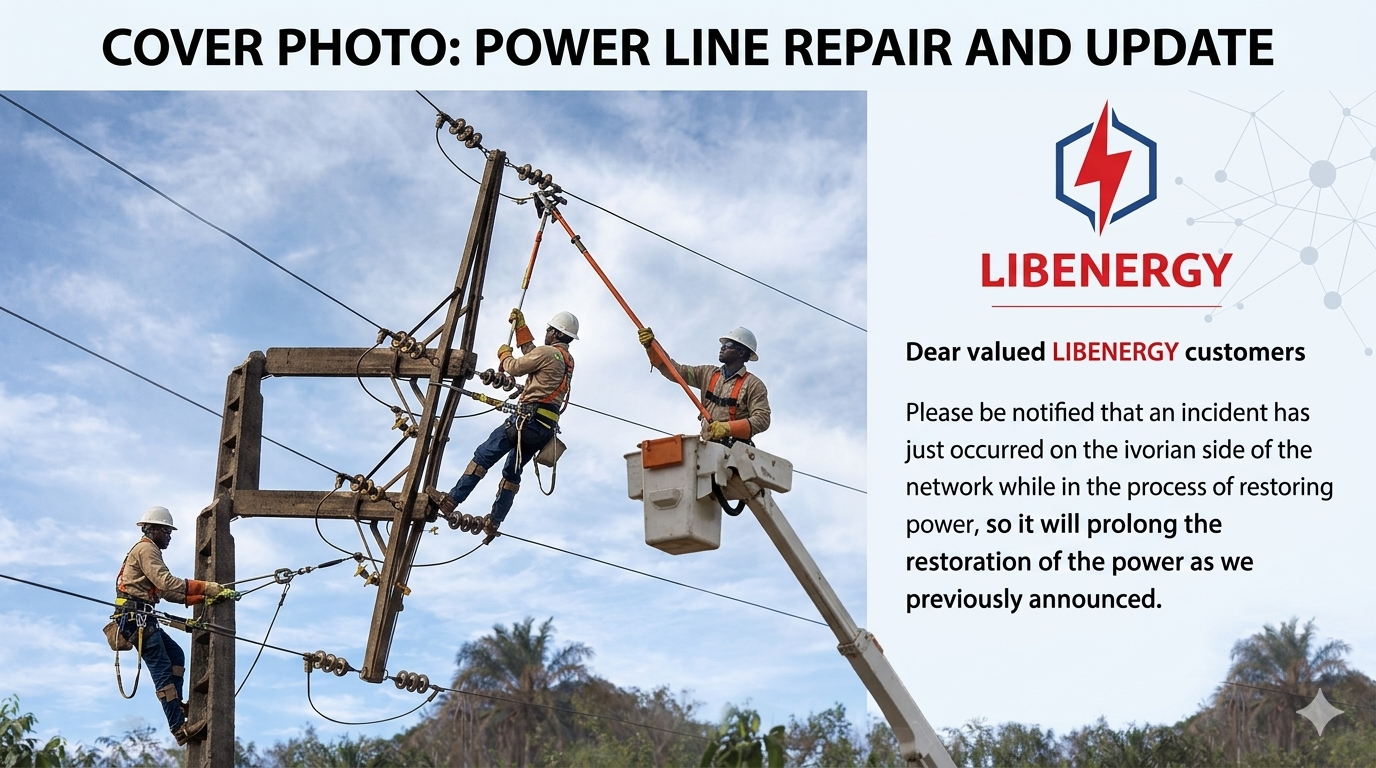
Earlier last week, a major technical fault originated within the Ivorian power utility (CIE) system. Since Côte d’Ivoire supplies the bulk of the 50MW contracted to the Liberia Electricity Corporation (LEC) for these regions, the failure triggered an immediate and total loss of power across the Liberian border.
Impact on the Southeast: 72 Hours of Crisis

For 72 hours, the consequences of the “Regional Ripple” were felt by every sector of society. The outage created a ripple effect of its own, straining essential services and the local economy:
- Healthcare: Hospitals in Pleebo and Fish Town faced a race against time. Facilities were forced to burn through expensive, limited diesel reserves to maintain “cold chains” for life-saving vaccines and to keep emergency room equipment operational.
- Commerce: Local entrepreneurs, particularly those in the fishing and cold-storage industries, reported significant financial losses as perishable goods spoiled.
- Public Safety: Local authorities noted an uptick in security concerns, as community hubs and residential corridors were left in total darkness, complicating night-time policing.
The Turning Point: Saturday Night Restoration
The restoration was the result of high-level coordination between the LEC and their Ivorian counterparts. Throughout Friday and Saturday, technical teams worked to bypass the fault and stabilize the transmission load.
The breakthrough came late Saturday night. By 11:00 PM, streetlights in Harper, Pleebo, and Fish Town flickered back to life, met with literal cheers from residents. The LEC confirmed shortly after that the “synchronization process” was successful and that the supply from the Ivorian grid had returned to its normal allocated levels.
“The lights coming back on wasn’t just about convenience; it was about safety and our livelihoods,” said one Harper resident. “Three nights is a long time to be in the dark.”
Looking Ahead: Stability and the Debt Debate
While the lights are back on, the incident has reignited a fierce debate regarding Liberia’s energy independence. Managing Director of the LEC, Mohammed M. Sherif, recently highlighted that while the government has made significant strides—paying upwards of US$20 million toward legacy debts owed to Côte d’Ivoire and Guinea—the system remains fragile.
Until local infrastructure can catch up, the southeast remains tethered to the stability of external suppliers. The government is currently pinning its hopes on the LEEAP (Liberia Energy Efficiency Access Project) to strengthen local distribution networks and reduce the impact of these “technical shocks.” For now, however, the region remains a passenger on a grid it does not fully control.