
By Rocheford T. Gardiner
SOUTH-EASTERN LIBERIA – While the asphalt pavement from Ganta to Tappita in Nimba County represents a significant leap forward in national infrastructure, a sobering reality is setting in further south. Even as feasibility studies begin for the 40km Tappita-to-Toe Town stretch, new and dangerous challenges are rapidly emerging along the corridor connecting Toe Town, Grand Gedeh, to Kanweaken, River Gee.
A Growing “Nightmare” on the Horizon
The road between Toe Town and Tiamah Town is increasingly riddled with deep potholes and severe “washboarding”—a wavy dirt formation locally referred to as “potato” road. These corrugated surfaces are more than just a nuisance; they are a deadly hazard. At high speeds, “washboards” cause vehicles, particularly lighter ones, to “float” or drift off the road, creating a high risk for accidents.
Furthermore, the lack of side-brushing has allowed thick foliage to reclaim the corridor, creating dense “canopies” between Zwedru and Kanweaken. These green tunnels prevent sunlight from reaching the roadbed, ensuring the ground remains saturated with rainwater. Local observers fear that if left unattended, these sections will quickly revert to the impassable mud traps that have historically plagued the region.

The “Improvised” Danger at the Boundary
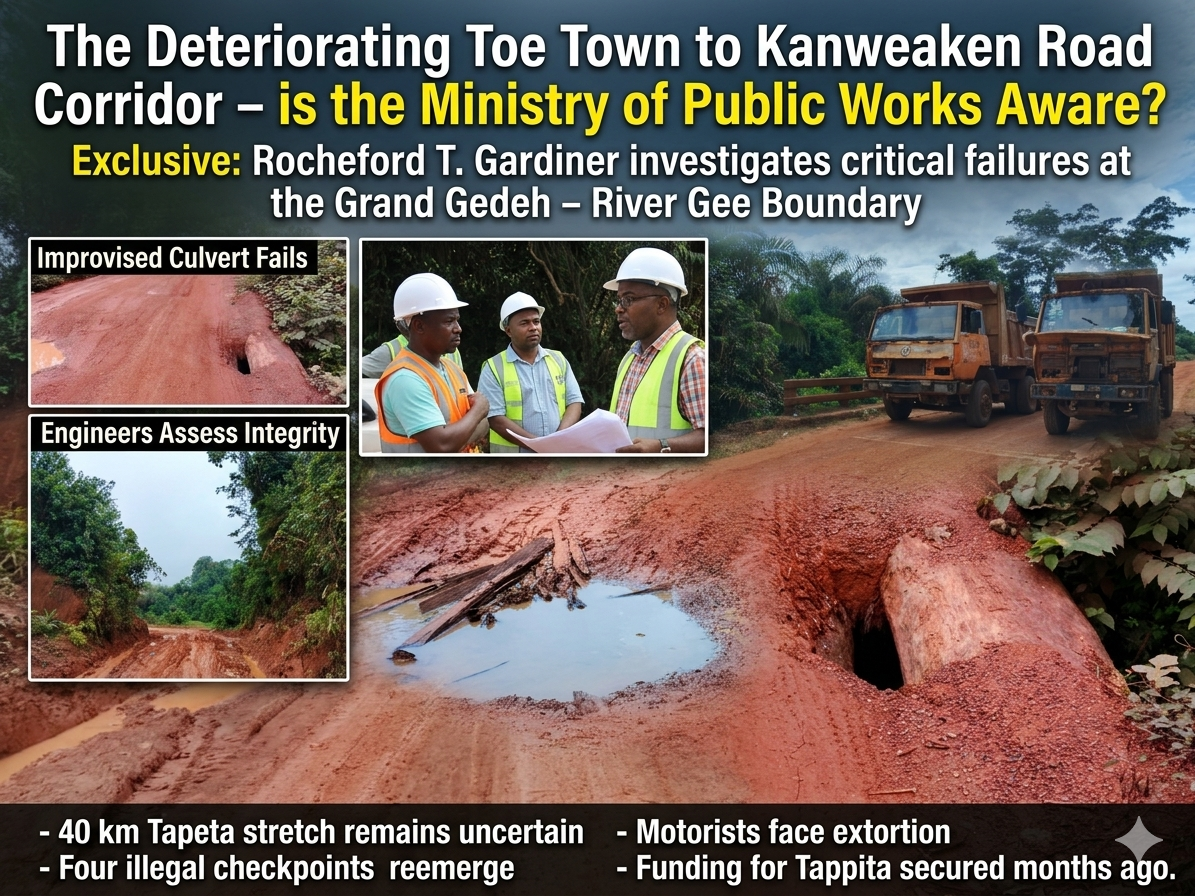
Perhaps the most glaring infrastructure failure sits at the infamous Grand Gedeh–River Gee boundary. In December 2023, Euro Logging installed three improvised culverts made of logs. Over time, the earth covering these logs has washed away, leaving the timber exposed with dangerous gaps between them.


This site remains a point of intense frustration. While road rehabilitation contractors successfully installed permanent concrete culverts at other points along the route, they inexplicably skipped these three trouble spots—the very areas that caused a total road cutoff three years ago. Why this critical junction remains neglected continues to baffle commuters and residents alike.


Glimmers of Hope Amid Delays


There is some movement on the horizon. Engineers from the Ministry of Public Works and the Chinese road construction firm, CICO, were recently spotted conducting integrity tests on a bridge roughly one kilometer outside of Toe Town.
CICO engineers confirmed they are preparing to begin work on the 40km Tappita stretch. While the Liberian government announced months ago that funding for this project has been secured, the engineers stopped short of providing a specific commencement date.
Extortion at the Gates: The Return of Checkpoints
The physical decay of the road is being matched by a resurgence of “illegal” security barriers. At least four unofficial checkpoints have re-emerged between Ganta and Zleh Town, directly defying Police Inspector General Gregory Coleman’s recent order to dismantle all unauthorized stops.
At these locations, Joint Security personnel are openly seen extorting monies from motorists in broad daylight. Commercial drivers report paying “gate-drop” fees ranging from $250 to $500 LRD for small vehicles and up to $1,500 LRD for trucks.
“To avoid the hassle, we just pay,” one frustrated driver at the Gbarnga checkpoint lamented. “If you refuse, they demand a full search, which means offloading and reloading everything. We don’t have the time to fight.”
A Region under Pressure
The proliferation of these checkpoints—occurring even at official stops—has left many wondering if the country is regressing to a wartime state. The practice is not only a violation of policy but a direct tax on the poor. In the Southeast, where the cost of basic services is often triple the rate in Monrovia due to logistical hurdles, these extortions add a crushing weight to an already struggling population.
As the rainy season approaches, the question remains: Will the Ministry of Public Works and the national security leadership intervene, or will the Southeast be left to drift further into isolation?
