
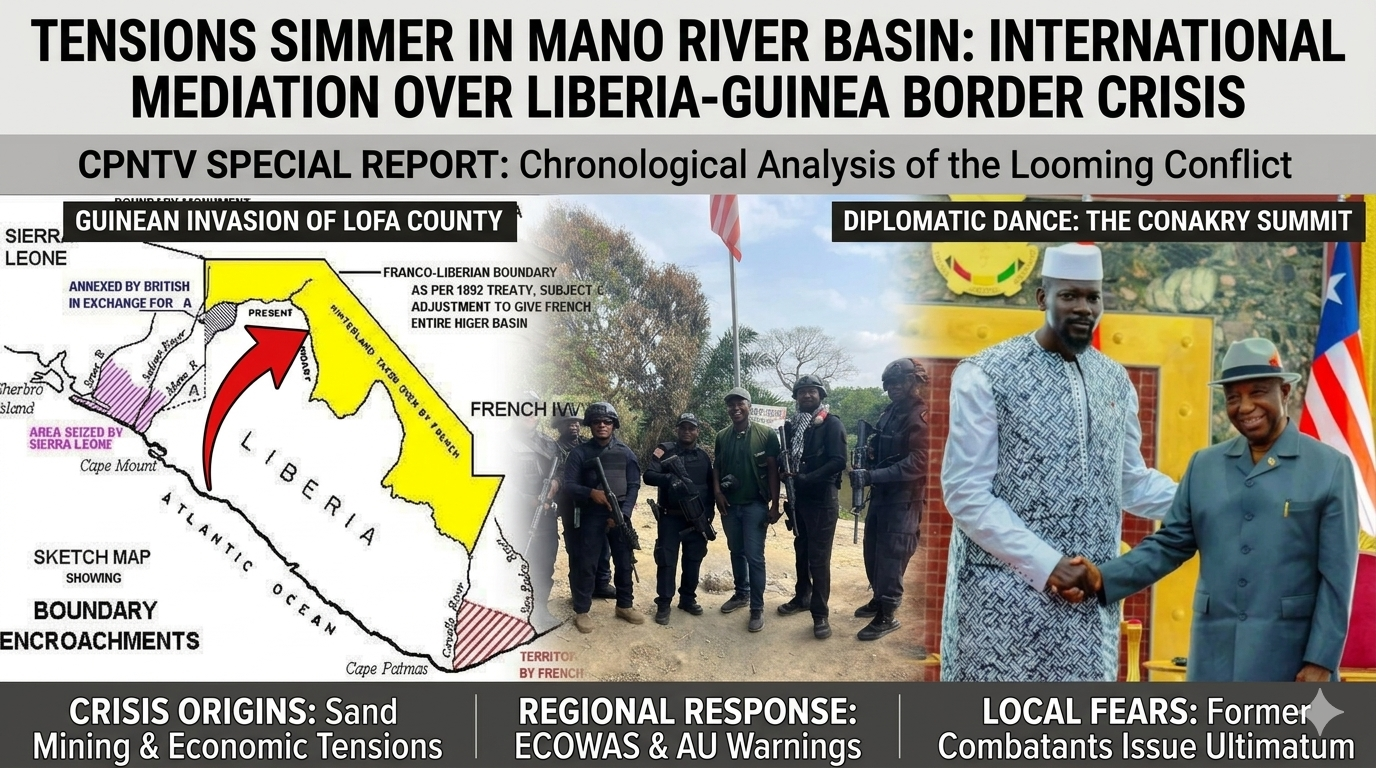
CPNTV brings a full chronological analysis of the looming crisis
MONROVIA, Liberia — A delicate diplomatic dance is underway in West Africa, marked by urgent international mediation and deep-seated local anger, as the regional economic bloc ECOWAS, the African Union (AU), and international powers scramble to defuse a border dispute between Liberia and Guinea that has threatened to ignite a regional conflict.
The crisis, which reached a peak in mid-March, centers on reports that Guinean troops crossed the border into Liberia, occupying at least two towns in Lofa County. While high-level meetings between the two nations have since led to a tense de-escalation, on-the-ground reports suggest the situation remains incredibly volatile, with local Liberians demanding a total withdrawal and some even threatening to take matters into their own hands.
Here is a full, analytical report on the evolving crisis.
Part 1: The Inciting Incident – “They Fired Shots and Raised Their Flag”
The quiet of early March was shattered in Lofa County, Liberia, when Guinean soldiers allegedly crossed the Makona River—which forms the natural border—and entered Liberian territory. Local officials from the Foya District reported that the soldiers entered the Sorlumba Clan and Kuonduo areas.
“They did not just cross; they came armed,” a local community leader told our reporters, speaking on condition of anonymity. “They fired sporadic shots into the air, terrifying the residents. We saw them hoist the Guinean flag. They claimed this was their territory.”
Analytical Insight: Why Now? The Economic Fuse
The timing of this incursion is critical. The Makona River basin is rich in resources, particularly high-quality sand essential for construction. In previous years, sand mining in this border area was an informal, collaborative cross-border activity.
However, in 2026, amid Guinea’s own internal transitions, local Liberian authorities began moving to formalize and tax this extraction, a shift that angered Guinean operators accustomed to free access. This move by Liberia, intended to regularize its resource extraction, acted as the economic fuse that sparked the military confrontation.
Part 2: The Diplomatic Offenses – ECOWAS, the AU, and the ‘A3’
The military incursion sent shockwaves through regional capitals. The fear was (and remains) a repeat of the Mano River wars that ravaged Liberia, Sierra Leone, and Guinea in the 1990s. The response was swift and multi-layered.
March 12: ECOWAS Lays Down the Law
Headquartered in Abuja, the ECOWAS Commission issued a stern warning. They described the situation as “deeply concerning” and demanded immediate “maximum restraint.”
The bloc’s strategy was two-pronged:
- Diplomatic Pressure: An ECOWAS statement emphasized “the need for both countries to maintain good neighborliness” and explicitly warned against “any unilateral actions that could jeopardize the peace and security of the sub-region.”
- Field Assessment: ECOWAS immediately announced the deployment of a high-level technical assessment mission to the border. This mission is crucial: its findings will officially define whether an “occupation” has legally occurred under international law, a ruling that could trigger more serious ECOWAS sanctions.
March 16-18: The AU and the Tripartite Summit
The African Union played a vital commendatory and legitimizing role. Following a critical emergency summit in Conakry, Guinea, on March 16—attended by President Joseph Boakai of Liberia, President Mamadi Doumbouya of Guinea, and President Julius Maada Bio of Sierra Leone—the AU praised the swift shift toward diplomacy.
AU Commission Chairperson Mahmoud Youssouf Ali called this an essential example of “African-led solutions.” The AU’s intervention was focused on moving the dispute into joint technical commissions to resolve the border line, rather than allowing it to remain a military issue.
The UN and the French Connection
The United Nations’ involvement has been quiet but significant, focused on preventing escalation.
- The A3: Liberia’s permanent representative to the UN, Ambassador Lewis G. Brown II, has been in close coordination with the “A3” (the three rotating African members of the UN Security Council). This diplomatic movement is designed to keep the border crisis high on the informal international agenda.
- France’s Role: Recognizing Guinea’s historical and military ties to France, President Boakai reportedly reached out directly to French President Emmanuel Macron to help mediate. On March 24, the French Ambassador to Liberia, Isabelle Le Guellec, confirmed that France supported the mediation efforts led by ECOWAS and the AU.
Part 3: The Current, Tense Reality – Withdrawal vs. Reality
The high-level diplomacy achieved an initial breakthrough. Following the Conakry summit, President Boakai informed the Liberian Senate that Guinea had “agreed to instruct its forces to return to their status quo positions.” This was presented to the public as a diplomatic victory. Strangely, the Guineans returned a couple days after withdrawing and now occupy another town in Liberia’s Lofa County
Tensions are rising;
- The Ultimatum: On March 23, less than a week after the Conakry “breakthrough,” former combatants from the Lofa County area held a tense press conference in Foya. They issued a one-week ultimatum to the Guinean forces to completely vacate the occupied towns. They warned that if the Guinean soldiers did not leave, they would mobilize themselves to “protect their land.”
- The “Buffer Zone” Trap: Analysis of local reports suggests that while the Guinean forces may have retreated from the town centers, they remain positioned along the Makona River, sometimes on the Liberian side. This creates a “gray zone” of occupation that the Guinean government may view as a security buffer, but which the Liberian population sees as a continuation of the invasion.
Conclusion and Final Analysis
The crisis in the Mano River Basin is a classic post-conflict border dispute where economic resources, vague historical boundaries, and internal political fragility intersect.
While ECOWAS and the AU have successfully prevented immediate war, the situation is far from resolved.
- The Success of Mediation: The international community succeeded in forcing President Doumbouya, whose regime is under its own pressure, to sit at the negotiating table. This proves the continuing power of regional diplomatic pressure in West Africa.
- The Persistence of the Threat: The real danger now is localization. If the local Liberian population (and the mobilization of former combatants) loses faith in the ECOWAS diplomatic track, a local skirmish could quickly spiral out of control, dragging both Monrovia and Conakry into a fight that neither truly wants but that national pride may make inescapable.
The next two weeks—and the results of the ECOWAS technical assessment—will decide if this is a minor resource dispute resolved by diplomacy, or the first chapter in a new and dangerous regional destabilization.
