
from our international contributors
DUBAI / WASHINGTON — In a dramatic shift that has sent shockwaves through global markets, the month-long conflict between the U.S.-Israeli coalition against Iran may be nearing a “calculated conclusion.”
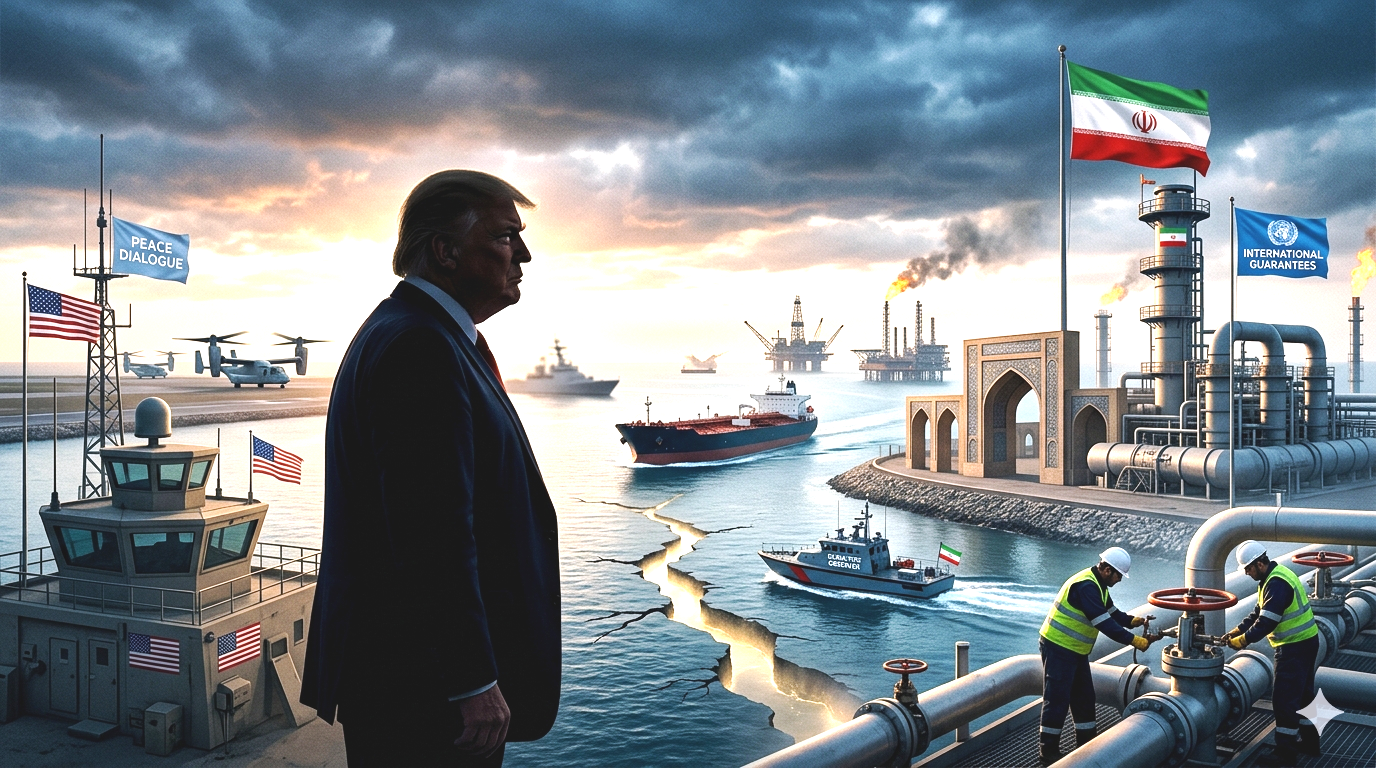
U.S. President Donald Trump announced early Wednesday that he intends to withdraw American forces from the immediate theater of conflict within two to three weeks, contingent on the verified neutralization of Iran’s nuclear capabilities. This follows a rare, albeit contested, diplomatic opening: Trump claimed on social media that Iran’s “new regime president” has formally requested a ceasefire—a claim Tehran publicly labeled “baseless” while simultaneously signaling a willingness to negotiate under strict security guarantees.


The Terms of Engagement
The diplomatic dance is being performed against a backdrop of intense military pressure. While the White House pushes a narrative of Iranian capitulation, Tehran’s Foreign Minister, Abbas Araghchi, clarified that while messages have been exchanged via U.S. Special Envoy Steve Witkoff, any permanent deal is predicated on three non-negotiable conditions:
- Legal Recognition: Formal recognition of Iran’s sovereign rights.
- Reparations: Compensation for the infrastructure damage sustained since the February 28 strikes.
- Non-Aggression Guarantees: Binding international assurances that neither the U.S. nor Israel will resume military operations against Iranian soil.
“We do not set deadlines for defending ourselves,” Araghchi told Al Jazeera, even as the U.S. threatens to “blast Iran back to the Stone Age” if the Strait of Hormuz is not immediately cleared of mines and naval blockades.
Market Reaction: “Warflation” and the $120 Barrel
The mere hint of a de-escalation caused a volatile “relief dip” in energy prices, though the global economy remains in the grip of what analysts call “limited warflation.”
Before the ceasefire rumors, Brent Crude surged past $120 per barrel following the total closure of the Strait of Hormuz on March 4. Since the conflict began, the global market has faced the loss of roughly 11 million barrels of oil per day and 140 billion cubic meters of gas—a shock the International Energy Agency (IEA) describes as more severe than the 1973 and 1979 oil crises combined.
| Metric | Pre-War (Jan 2026) | Peak Conflict (March 2026) | Current Outlook |
| Brent Crude Price | ~$75/bbl | $120+/bbl | $103/bbl (Volatile) |
| U.S. Gas (Avg) | $3.10/gal | $4.50/gal | $4.10/gal |
| Strait of Hormuz | Open (21M bpd) | Closed/Blocked | Negotiating Passage |
The Long Road to Recovery: Restoring “Pre-War Status”
While Trump’s “three-week exit” timeline suggests a quick political resolution, energy experts warn that the physical restoration of the oil and gas sector will take significantly longer.
According to IEA Chief Fatih Birol, at least 40 major energy assets in the Gulf—including Saudi refineries, Qatari LNG terminals, and Iranian export hubs like Kharg Island—have sustained “severe to very severe” damage.
Timeline for Restoration:
- 1–2 Months: Clearing the Strait of Hormuz of naval mines and sunken vessels to allow safe passage for VLCCs (Very Large Crude Carriers).
- 6–12 Months: Repairing specialized “long-lead” infrastructure at damaged refineries and desalination plants.
- 2+ Years: Restoring global “trust” and lowering insurance risk premiums, which have currently made shipping in the Persian Gulf prohibitively expensive.
“Even if the shooting stops tomorrow,” noted one Rystad Energy analyst, “the world is looking at a ‘Higher for Longer’ energy price environment. We won’t see true pre-war stability until at least mid-2027.”
As the world awaits Trump’s scheduled national address on April 2, the question remains: Can a “paper tiger” peace hold long enough to keep the global economy from a total 1970s-style stagflationary collapse?