
by Rabbi Joseph Gbaba, Ed. D.
Introduction
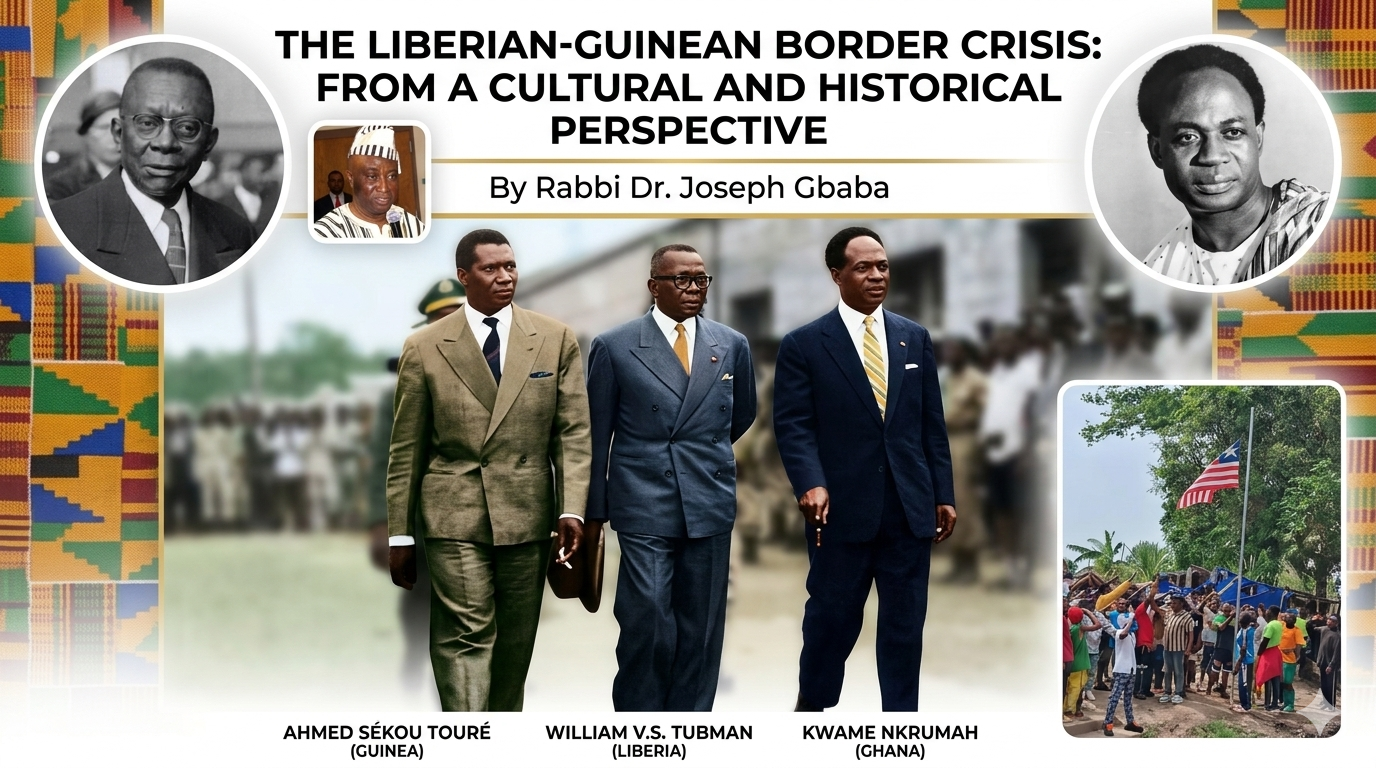
I personally have some profound memories of three West African countries that I want to share with you. Those memories began during the Sanniquillie Conference, which took place July 15–19, 1959. It was there that three great sons of Africa—Presidents William V.S. Tubman of Liberia, Ahmed Sékou Touré of Guinea, and Kwame Nkrumah of Ghana—met to “hang heads” and chart a path toward the total liberation of Africans from the yoke of colonialism and imperialism. That summit subsequently led to the formation of the Organization of African Unity (OAU, now the AU) in 1963.
The Sanniquillie Conference took place sixty-seven years ago. Guinea had gained her independence just a year earlier, on October 2, 1958, and Ghana had gained hers on March 6, 1957. I was five years old then, and I was among the massive crowds that assembled each day to watch history unfold.


If my memory serves me right, President Tubman was a charismatic host, smoking a cigar every time he appeared in public; one could see his bulging eyes behind his eyeglasses as he puffed his cigar and waved his white handkerchief to the jubilant crowd. Ahmed Sékou Touré was a gallant sight to see: tall, ebony black, dressed in a pure white gown and a white cap—a proud Pan-Africanist. Then there was the Osagyefo, Dr. Kwame Nkrumah, an intellectual par excellence and an eloquent public speaker. President Tubman was sandwiched by these two distinguished leaders: Papa Sékou Touré on his left and the Great Kwame Nkrumah on his right. That day, the whole world stood still. You could feel the presence of Almighty God and the spirits of our African forefathers in our midst.
History and Culture Are Intertwined
History and culture are intertwined. Metaphorically, they are brothers and sisters, just as Liberia and Guinea are two sisterly African nations. In other words, Guinea is Liberia’s “small sister,” but Guinea is not Liberia’s enemy.
It is true that you may occasionally make a mistake and bite your tongue while enjoying a delicious meal. It is painful, but it does not mean you must cut your tongue off or uproot your teeth. No. You let the pain subside and then resume using your tongue and teeth to eat once again.
Therefore, for those who do not know, please remember: Guinea is Liberia’s sister. The two nations share many cultural traits, ethnic groups, and landscapes. Do not forget that when our own warlords and greedy politicians were burning mosques and giving children guns to fight their battles, Guinea was the place where most Liberians in northern Liberia ran for safety. Remember this, especially since we still have former warlords holding high government positions who promote chaos to justify their inclusion, walking around as “King Kongs” while holding us hostage economically.
Viewing the Border Crisis from a Cultural Perspective
From our traditional African perspective, it is forbidden for Liberians and Guineans to shed one another’s blood because we are blood relatives. Guineans are industrious and peaceful. We have benefited from the immense contributions Guinean immigrants have made to Liberia, especially in commerce and transportation. Over time, due to our generosity and interethnic marriages, many Guineans naturalized and became Liberian citizens.
Even as I write this, many Liberians of Guinean descent hold prominent positions in the Liberian government: Representative Musa Bility; Bushuben Keita, Legal Advisor to President Boakai; Mamaka Bility, Assistant Minister of State for Presidential Affairs; and Mrs. Fofana, Presidential Press Secretary. I could go on naming names until judgment day.
Furthermore, during our darkest hours, the Republic of Guinea contributed troops to the ECOMOG peacekeeping force. The Guinean contingent was devoted to the restoration of law and order, and many Guinean soldiers shed their blood to restore our dignity and sovereignty. Guineans respect us as Africa’s oldest Republic; we must reciprocate that respect.


Conclusion
I would like to conclude by thanking the youth of Lofa County for their patriotic deeds in bravely re-hoisting the Liberian Lone Star flag after it was lowered by Guinean soldiers. This incident is a manifestation of a decline I forewarned President Boakai about in 2023. I advised him then about the gradual extinction of Liberian culture and the educational system, offering to assist his administration through consultancy.

Unfortunately, my warning fell on deaf ears. For three years, I have shared communications with the President’s closest advisors—including Koffi Woods, Bushuben Keita, Samuel Nagbe, Anthony Kesselly, and others—yet I have received no response.
I am sharing this because while the President invites the diaspora to return and contribute, his advisors are creating stumbling blocks. This is a direct sabotage of his ARREST Agenda. This is a time for peace and reconciliation, not hate and tribalism. The incident between our two nations calls for the involvement of experienced senior citizens. I hope the Boakai administration will address why the voices of its citizens are being sidelined. No government can succeed by segregating its citizens based on ethnic or political affiliations.
Long live the Liberia and Guinea union. Vive l’union entre le Libéria et la Guinée!
Rabbi Prince Joseph Tomoonh-Garldoeyh Gbaba, Sr., Ed. D. March 29, 2026
How to Donate to the DATI Performing Arts Project in Liberia

- CashApp: $JosephGbaba | Tel: (267) 973-1709
- Zelle: Joseph Gbaba | Tel: (267) 973-1709
- Check/Money Order: Dehkontee Artists Theatre, Inc., P.O. Box 143, Clifton Heights, PA 19018
