
Exclusive Report by Rocheford T. Gardiner
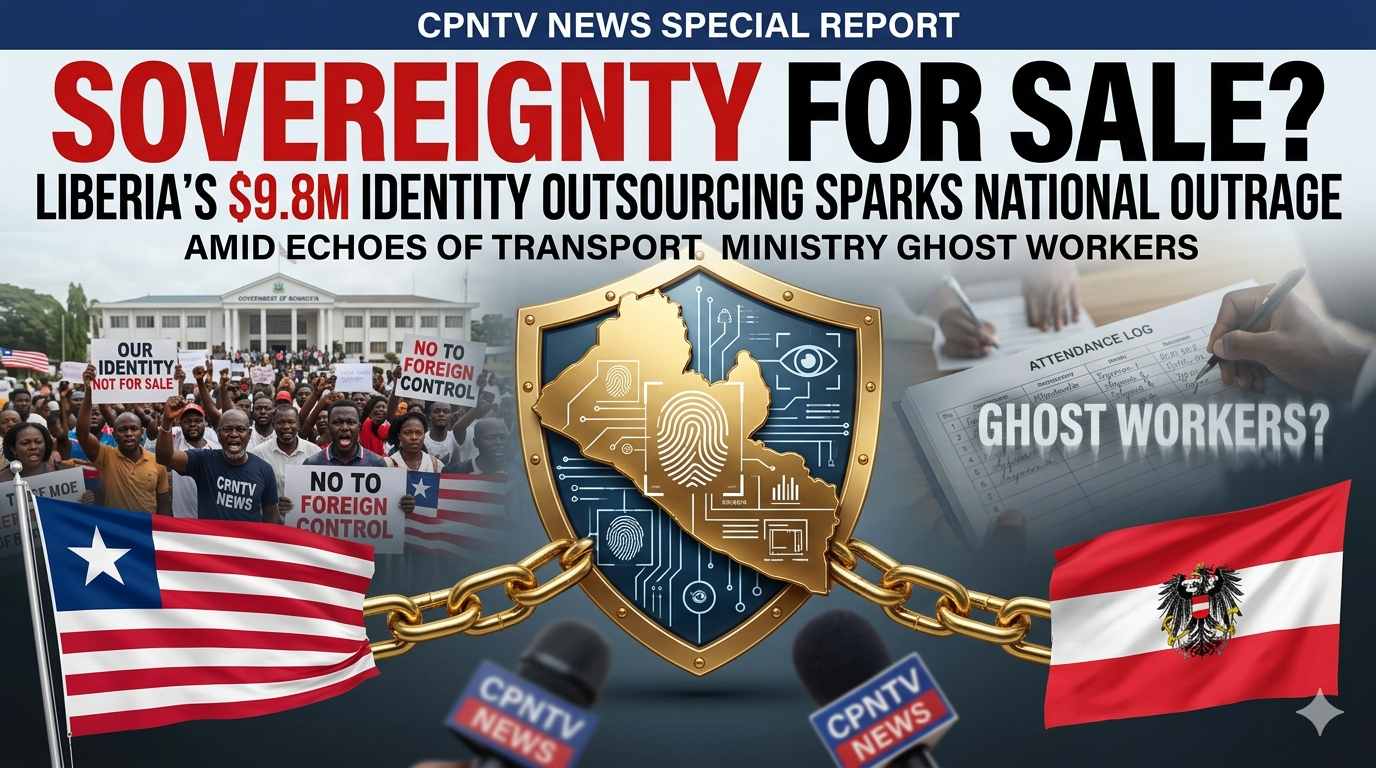
MONROVIA — The Executive Mansion’s recent decision to circumvent procurement watchdogs and hand control of Liberia’s National Biometric Identification System (NBIS) to Austrian firm OSD International has triggered a volatile national debate. While the administration frames the $9.8 million contract as an emergency technological rescue mission, a growing coalition of citizens, civil society organizations, and policy analysts view it as a frustrating surrender of data sovereignty.
The deal has hit a raw nerve across the country, amplifying public resentment over a recurring pattern in Liberian governance: the systemic outsourcing of core state mandates to foreign entities while tax-funded civil servants are left sitting in empty offices, drawing checks for doing absolutely nothing.
For the average Liberian, the national identity card is not merely a piece of plastic; it is the fundamental proof of citizenship, the gateway to banking, and the anchor of the electoral roll. Handing the keys to this repository of biometric data to a foreign enterprise has provoked deep-seated anxiety regarding privacy and constitutional pride. Critics argue that the National Identification Registry (NIR) should have been capacitated internally rather than being effectively leased to a European contractor, pointing out that national identity is an inalienable pillar of state sovereignty that should never be commoditized or placed in foreign hands.
The Echoes of LTM: When Outsourcing Breeds State Paralysis
This public resentment does not exist in a vacuum. To understand why Liberians are so deeply cynical about the NIR-OSD deal, one needs only to look across the capital to the ongoing crisis at the Ministry of Transport (MoT). The parallel is as stark as it is damning.
Following an outsourcing agreement between the government and Lebanon Transport Management (LTM), the printing and administration of vehicle registration plates, driver’s licenses, and transport certificates were transferred entirely to the private vendor. Ostensibly, the deal was meant to introduce efficiency and curb corruption. Instead, it systematically hollowed out the ministry from the inside.
Under the LTM contract, core technical departments within the Ministry of Transport were stripped of their functional duties. Entire divisions of civil servants—highly trained technicians, enrollment officers, and administrative staff—suddenly found their daily responsibilities completely legally usurped by LTM employees operating out of private offices.
Today, dozens of government employees report to the Ministry of Transport daily, sign attendance logs, and spend eight hours in forced idleness because the machinery, software, and mandate belong to a foreign company. At the end of every month, these “ghost workers in broad daylight” are still paid by the Liberian treasury, creating a massive fiscal drag while destroying public sector morale.
The anxiety pulsing through the corridors of the National Identification Registry today is that the OSD deal will replicate this exact dysfunction. With 500 new biometric kits arriving and 500 enrollment centers being deployed nationwide under OSD’s technical oversight, local NIR staff fear they are being reduced to mere bystanders in their own institution—on track to become highly subsidized spectators while Austrian technical managers run the state’s primary database.
The Presidential Paradox: Procurement Rules vs. Executive Urgency
The resentment has been supercharged by the political maneuvering behind the contract. Internal documents revealed that the Public Procurement and Concessions Commission (PPCC) rejected the NIR’s push for a restricted bidding process, explicitly declaring that a project of this magnitude demanded International Competitive Bidding (ICB).
Yet, President Joseph Boakai overrode the PPCC’s legal red flags via an executive memorandum, ordering the contract to move forward under the cover of national urgency. While the administration defended the move by pointing to the near-total collapse of ID issuance in 2025—where broken equipment, long queues, and system crashes had effectively disenfranchised citizens—the bypassing of legal safeguards has left a bitter taste in the mouths of anti-corruption advocates.
Whispers of foul play were further exacerbated by local investigative reports suggesting that some officials had tried to extort a $120,000 bribe from OSD, an allegation that exposed the fractured, chaotic reality behind the scenes.
The Fiscal Silver Lining: How the OSD Deal Generates Revenue
Despite the intense political and nationalist backlash, economists and financial analysts within the Ministry of Finance and Development Planning argue that from a purely fiscal standpoint, the modernized biometric system represents an unprecedented windfall for government revenue generation.
If implemented transparently, the system is projected to reverse decades of leakages through several critical channels:
| Revenue / Savings Mechanism | Operational Framework | Primary Fiscal Impact |
| Elimination of Payroll Fraud | Biometric matching of the entire civil service roster against the central NIR database to permanently delete duplicate profiles. | Saves millions annually by completely eliminating “ghost names” from the government payroll. |
| Formalizing the Informal Economy | Mandatory integration of secure National IDs with mobile money wallets, banking protocols, and commercial business registries. | Massively expands the direct and indirect tax base by bringing informal traders into the financial grid. |
| Securing Fee Collection | OSD’s centralized system eliminates manual cash handling at enrollment centers, replacing it with traceable digital payments. | Plugs direct leakages and prevents local bribery, ensuring 100% of ID card fees reach the Consolidated Fund. |
| Inter-Agency Data Integration | Real-time biometric validation linked to passport issuance, driver licensing, and corporate tax filings (LRA). | Enhances tax enforcement and multi-agency compliance, closing loopholes used for identity and tax evasion. |
The government’s defense rests entirely on this economic calculus. By establishing an un-hackable, centralized registry, the administration aims to build a modern digital economy where identity verification can be monetized across banking, telecommunications, and tax compliance, generating millions in non-tax revenue while drastically lowering the cost of public service delivery.
A Nation at a Crossroads
To steer this volatile transition, the President’s appointment of National Security Advisor Samuel Kofi Woods to head a high-level Steering Committee underscores that the administration now views the national identity crisis not just as an administrative hurdle, but as a critical national security threat.
Liberia stands at a precarious crossroads. The $9.8 million partnership with OSD International will undoubtedly bring advanced biometric infrastructure and operational efficiency to an enrollment process that had ground to a painful halt. However, until the executive branch can prove that it can secure foreign expertise without turning its own civil servants into idle, demoralized spectators—as seen in the tragic precedent at the Ministry of Transport—the project will continue to face fierce resistance from a populace deeply weary of seeing the instruments of their sovereignty outsourced to the highest foreign bidder.

© 2026 CPNTV News. All rights reserved. This special investigative report is compiled for broadcast and digital syndication.