
by Rocheford T. Gardiner
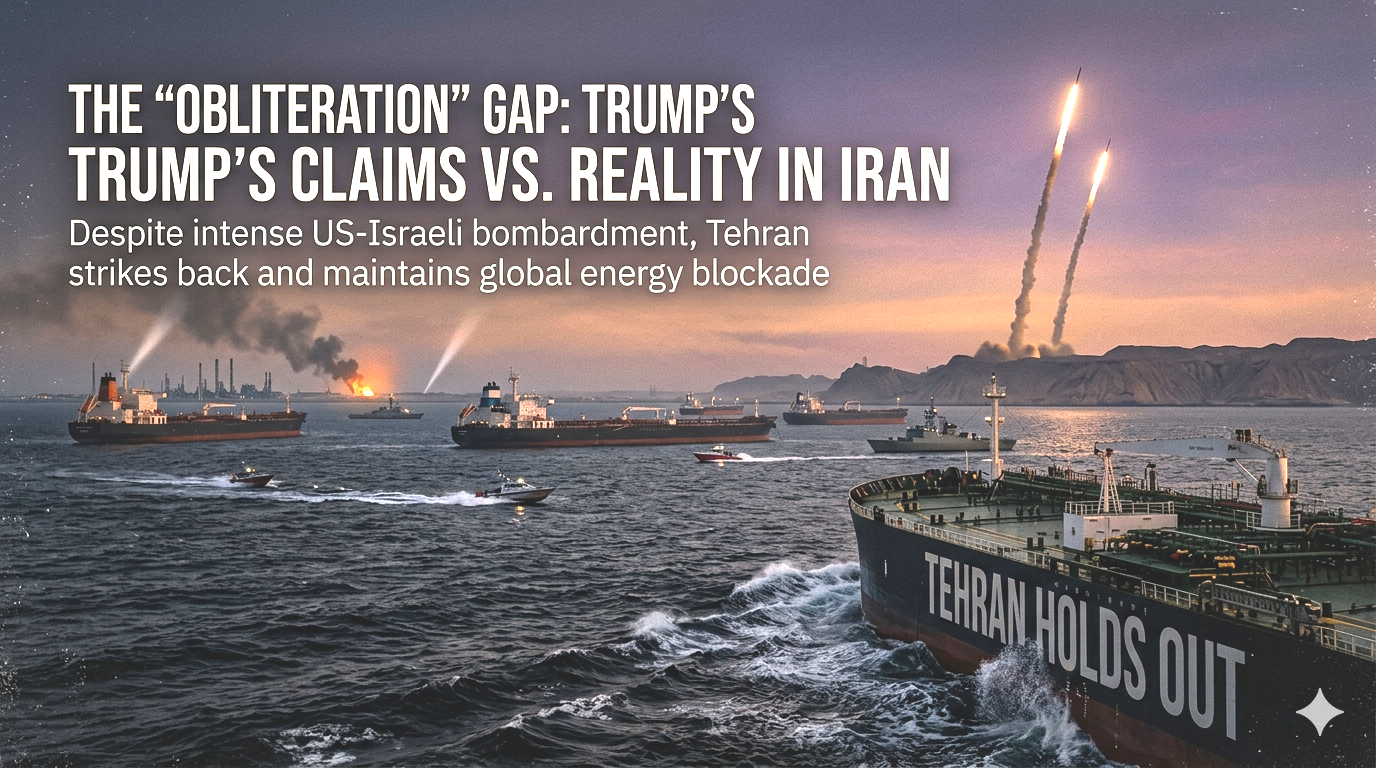
TEHRAN / WASHINGTON — In the fifth week of the escalating conflict in the Middle East, a deepening disconnect has emerged between the White House’s rhetoric and the reality on the ground. Despite President Donald Trump’s repeated assertions that he has “completely obliterated” Iran’s military capability, the Islamic Republic continues to launch sophisticated retaliatory strikes, maintaining an effective blockade of the world’s most vital energy artery.
The conflict, which began on February 28, 2026, with the joint U.S.-Israeli “Operation Epic Fury,” was, according to them, intended to neutralize Iran’s nuclear and missile programs – a program Iran has always maintained is peaceful. In recent days, President Trump has doubled down on his victory claims, stating on social media that U.S. forces have destroyed “100% of Iran’s military capability.”
However, defense analysts and regional reports suggest a far more complicated picture. While the initial wave of nearly 900 strikes—which reportedly killed Supreme Leader Ali Khamenei—severely crippled traditional command structures, Iran’s decentralized drone and missile units remain functional and lethal.
The “Obliteration” Gap
The disconnect between Washington’s narrative and the tactical situation is most visible in the continued Iranian counter-strikes. Since the start of the war:
- Regional Retaliation: Iran has launched hundreds of drones and ballistic missiles targeting U.S. bases in Bahrain, Qatar, and the UAE, as well as Israeli territory.
- Infrastructure War: While Israel has focused heavily on Iranian civilian infrastructure—including power plants, schools, and medical facilities—Tehran has responded by hitting energy hubs like Qatar’s Ras Laffan LNG complex, causing long-term damage to global gas supplies.
- U.S. Casualties: Despite claims of total victory, the Pentagon has confirmed at least 15 U.S. soldiers killed and over 300 wounded, with billions of dollars in equipment damage across the Middle East. Other sources however claim that the US has lost up to 1,000 military personnel.
The Strait of Hormuz: A Global Stranglehold
Perhaps the greatest challenge to the “obliteration” narrative is Iran’s continued control over the Strait of Hormuz. Effectively closed to any vessel associated with the U.S. or its allies, the blockade has triggered the largest energy supply disruption since the 1970s.
“We destroyed 100% of their capability… except for the drones, mines, and speedboats they are using to shut down the Strait,” noted political analyst Ted Widmer in a recent critique of the administration’s strategy.
| Economic Impact (March 2026) | Statistic |
| Global Oil Supply Reduction | ~20% |
| Brent Crude Price | Surged past $120/barrel |
| Regional Oil Production | Dropped by 10 million barrels per day |
| Maritime Traffic | 70% reduction through the Persian Gulf |
Escalation and Civilian Toll
As the diplomatic stalemate continues, the human cost is mounting. UN Human Rights Chief Volker Türk recently warned that the war has entered a “dangerous phase,” with strikes increasingly shifting toward densely populated areas. The Iranian Red Crescent reports that over 67,000 civilian sites have been impacted, including UNESCO World Heritage sites and nearly 500 schools.
In Washington, the administration has threatened even harsher actions, including the potential seizure of Kharg Island, the terminal responsible for 90% of Iran’s crude exports. President Trump told reporters on Sunday, “Maybe we take Kharg Island, maybe we don’t. We have a lot of options,” even as military experts warn that a ground operation would lead to significant U.S. casualties.
A War of Attrition
Despite facing “indiscriminate bombardment,” Tehran’s ability to hold out has baffled some Western strategists. The regime appears to be leveraging its remaining asymmetric capabilities to drive up global energy prices, betting that economic pressure on Europe and Asia will eventually force the U.S. and Israel to the negotiating table.
With oil prices daily hitting new highs and the “Special Relationship” between the U.S. and its European allies fraying under the strain of the energy crisis, the question remains: Has Iran’s military been obliterated, or has it simply evolved into a more elusive and dangerous foe?