
by Rocheford T. Gardiner
Cape Palmas, Liberia – Since taking the oath of office with a promise to “rescue” Liberia, President Joseph Nyuma Boakai’s administration is finding itself increasingly entangled in a web of controversy. The central grievance? A growing list of high-profile appointments that critics argue signals a dangerous return to tribalism, nepotism and sectionalism.
Despite the President’s “Arrest” agenda (Agriculture, Roads, Rule of Law, Education, Sanitation, and Tourism), a new list circulating in political circles suggests a different priority: the “Lofazation” of the Liberian government.
The “Lofa 32”: A Demographic Imbalance?
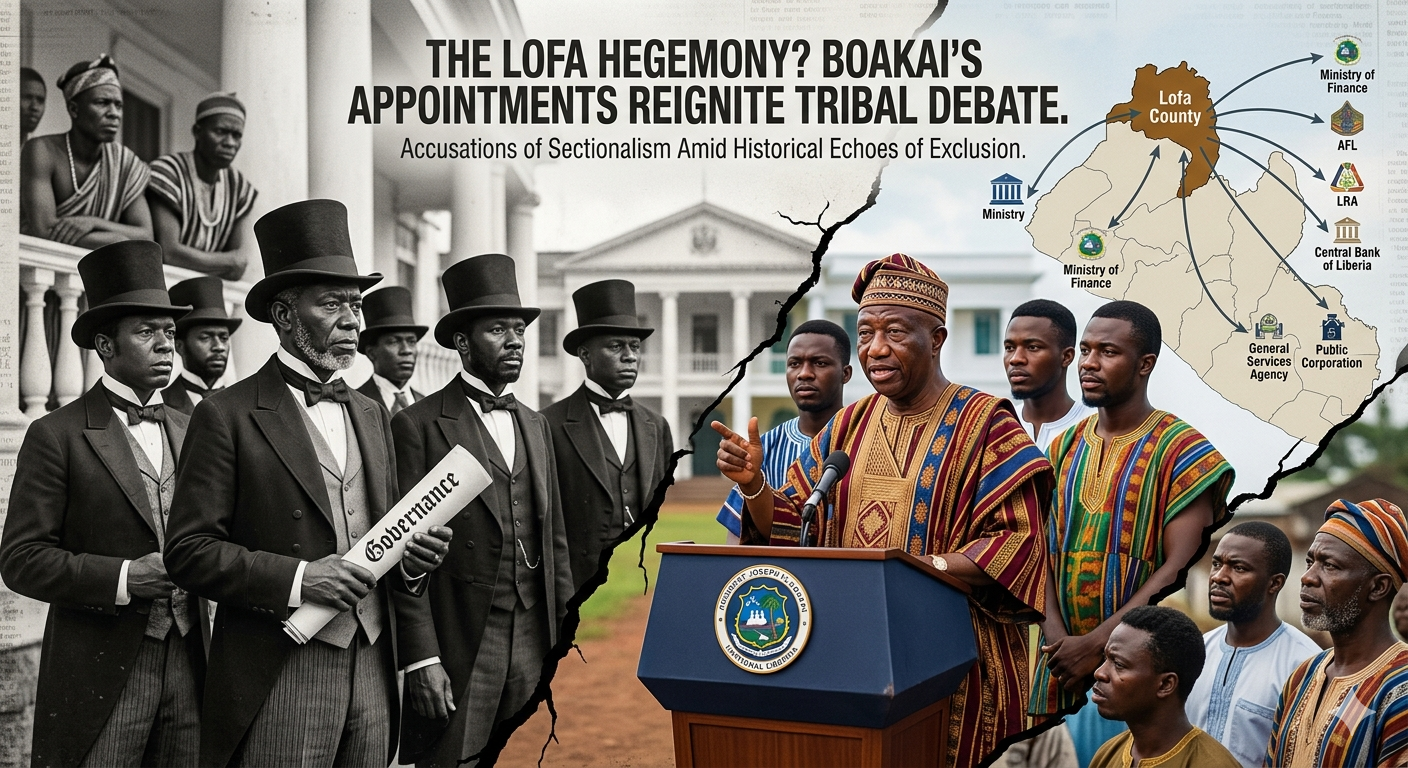
Data emerging from the Executive Mansion reveals that at least 32 key positions—ranging from the Ministry of Finance to the Armed Forces of Liberia—are now headed by individuals from the President’s home county, Lofa.
The concentration of power is not merely symbolic; it reaches into the very engines of the state’s economy and security. High-profile appointments include:
- Financial Gatekeepers: Augustine Kpehe Ngafuan II (Finance Minister), James Dorbor Jallah (LRA Commissioner General), and Henry Saamoi (Executive Governor of the Central Bank).
- Security & Justice: Col. Davidson T. Forleh (AFL Chief of Staff) and Cllr. Augustine C. Fiyah (Solicitor General).
- Essential Services: Jarso Maley Jallah (Education), Sekou M. Kromah (Post & Telecommunications), and Josiah F. Joekai, Jr. (Civil Service Agency).
While the administration maintains these individuals are qualified professionals, the sheer volume of kinsmen in the cabinet has sparked outrage among those who feel other counties are being sidelined in the “Rescue Mission.”
The Bitter Irony of History
The current accusations carry a heavy sense of historical irony. For over a century, the Americo-Liberian/Congo elite dominated the political landscape, a period defined by the exclusion of the indigenous “country people.”
During the 1970s and leading up to the 1980 coup, indigenous activists—the fathers of the very movement Boakai represents—vocalized a fierce rejection of nepotism and minority rule. They argued that the “Congo” hegemony treated Liberia as a private estate.

Today, critics point out that the “country people” who once fought for inclusion are now being accused of the very same sin: Tribalism and nepotism. Instead of a broad-based indigenous coalition, the focus has narrowed from “Indigenous vs. Congo” to “Lofa vs. The Rest of Liberia.”
An Arguable Justification
An arguable justification for Boakai could point to the previous regime of President George Weah. Even though there were some form of inclusion or another, of other tribes and regions, (save the Americo-Liberians/Congos), the “meaty” slots and positions were mostly allotted to south easterners – the home region of Weah.
Boakai’s respite could stem from the fact he has shown some level of “favor” towards remnants of the Americo-Liberians/Congos establishment – something accentuated in the recent symbolic reburial of President William R. Tolbert and the relative “ease of access” they still maintain with the president. During the Weah administration, “backslidden pundits” of the CDC like Eugene Fahngon, coined a name for the regime at the time – “The South Eastern Company.”
A Pattern of Pain: How Tribalism Scars Liberia
Liberia’s history is a testament to the fact that when governance is viewed through a tribal lens, stability becomes fragile.
- The 1980s Divide: After Samuel Doe took power, the initial hope for indigenous liberation quickly soured as the administration became dominated by the Krahn tribe. This sparked deep-seated resentment, particularly among the Gio and Mano ethnic groups.
- The Civil War: These ethnic divisions were the primary fuel for the Liberian Civil War. The conflict wasn’t just about political power; it was a brutal settling of scores between tribes who felt excluded or oppressed by the tribalism of the state.
- Institutional Decay: When loyalty to “the soil” (one’s county) supersedes loyalty to the Republic, meritocracy dies. This leads to inefficient bureaucracies where accountability is shielded by ethnic solidarity.
The Silence of the Mansion
As the list of Lofa appointees grows—most recently including Jonathan Weedor—the President has remained largely silent on the criticism. Supporters of the President argue that he is simply choosing people he trusts to execute his vision.
However, in a country still healing from the wounds of civil strife, the perception of exclusion can be just as damaging as the reality. For many Liberians, the “Rescue Mission” will only be successful if it rescues the nation from the cycle of tribal politics, rather than simply changing which tribe sits at the head of the table.
“When the government looks like a county meeting rather than a national cabinet, the seeds of discord are sown,” says one political analyst in Monrovia. “Liberia belongs to 15 counties, not just one.”